The War of the Bucket: Medieval Italy’s Strangest War
The War of the Bucket: Medieval Italy’s Strangest War
Some wars are remembered for the empires they built or the kings they crowned. This one is remembered for a bucket.
In the year 1325, two of northern Italy’s proudest cities marched tens of thousands of men into the hills between them and fought a battle that left around two thousand dead. The story that as echoed down the centuries says it all began with a humble wooden pail, stolen from a well in the dead of night. It sounds like a joke. It became one of the largest battles in medieval Europe.
But like so many of history’s best stories, the truth is stranger, and darker, than the legend. The bucket everyone remembers may have had almost nothing to do with why the war started at all.
A Land Divided
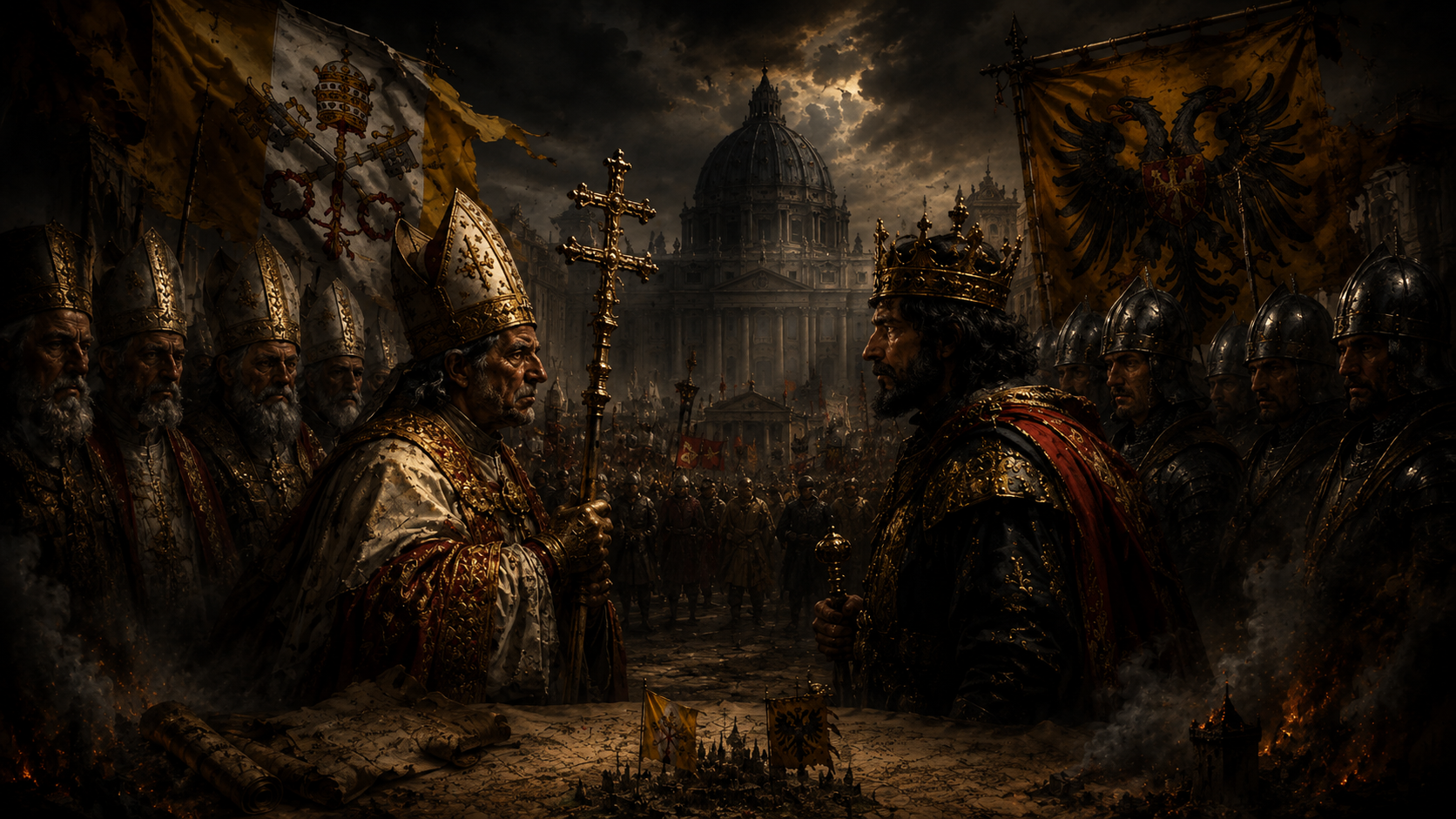
To understand the War of the Bucket, you have to understand the world that produced it. For more than three centuries, the cities of northern Italy were torn apart by one enormous quarrel: who should rule the Christian world, the Pope or the Holy Roman Emperor?
Those who backed the Pope were called Guelphs. Those who backed the Emperor were called Ghibellines. This was not a polite political disagreement. It was a generational feud that set neighbor against neighbor, family against family, and city against city. Towns changed sides, exiled their rivals, and raided each other’s lands for the better part of three hundred years.
Bologna was a Guelph city, loyal to the Pope. Modena, only about thirty miles away, was Ghibelline, loyal to the Emperor. They had been trading insults, ambushes, and border raids for generations.
By the 1320s, the tension was a fire waiting for a spark. The capture of a Bolognese
castle by Modena, and the ongoing fight over contested territory, pushed the two cities toward open war. The bucket, as we will see, was almost an afterthought.
The Battle of Zappolino
On 15 November 1325, as the late autumn light was already fading, the two armies finally met near the village of Zappolino, in the rolling country of what is now Emilia-Romagna.
The numbers were almost comic in their imbalance. Bologna, confident in its size and wealth, fielded a vast force of roughly 32,000 men, a great sprawling host of citizen militia, allied troops, and hired soldiers.
Modena could muster only about 7,000. By most counts, Bologna outnumbered its enemy by nearly five to one. On paper, it should have been a slaughter in Bologna’s favor.
It was a slaughter, but not the one anyone expected.
Bologna’s enormous army was its own undoing. Large medieval armies were notoriously difficult to command. Orders traveled slowly, the line was spread thin and disorganized, and overconfidence had set in before a single blow was struck. Modena’s smaller force, by contrast, was tightly led, well drilled, and supported by hardened cavalry. As dusk fell, the Modenese horsemen drove a concentrated charge straight into a weak point in the Bolognese line.
The huge army cracked. Confusion turned to panic, and panic to flight. Within hours the battle was over, and it was Bologna’s soldiers who were running. The Modenese, scarcely able to believe their luck, gave chase all the way back to the gates of Bologna itself.
Salt in the Wound
What happened next was less a military campaign than a public humiliation, delivered with cruel medieval flair.
The Modenese could not, and chose not to, take the great walled city of Bologna. Instead, they set about wounding its pride. They destroyed outlying castles. They sabotaged a sluice on the Reno river, cutting off part of the city’s water supply. According to tradition, they even staged a mocking palio, a kind of festive horse race, right outside the city gates, daring the humiliated Bolognese to come out and watch.
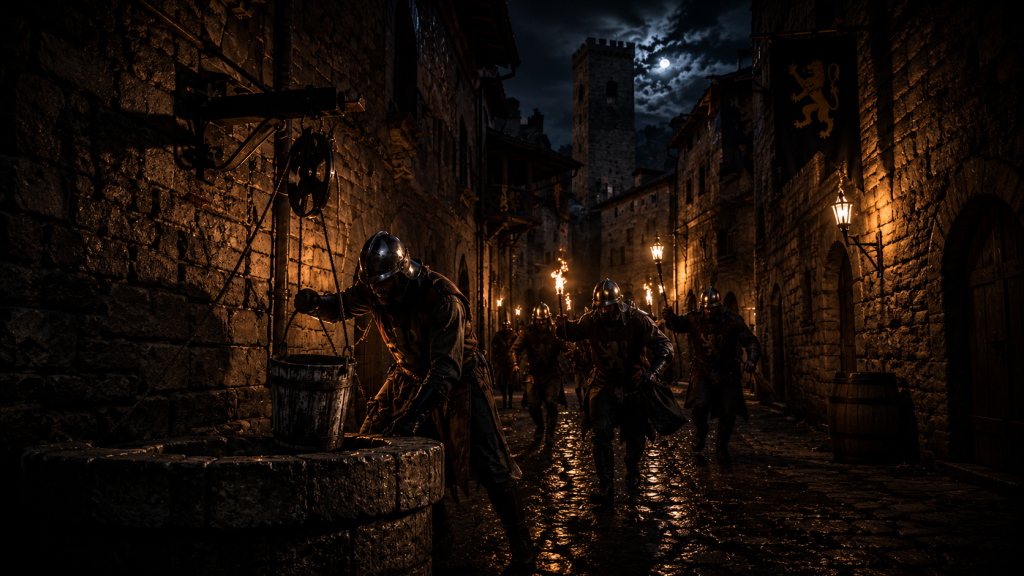
And then, the legend says, before turning for home, they took a bucket from a well outside the city. Why would Bologna need it, the joke went, when Modena had already taken its water?
The Truth About the Bucket
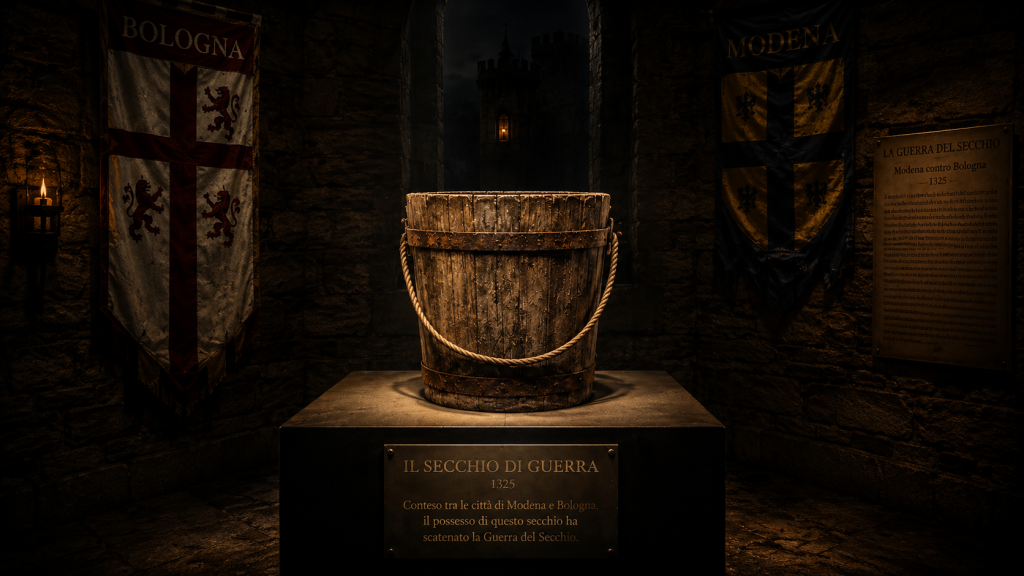
Here is where the famous story and the historical record begin to part ways. For centuries, the tale has been told as if the entire war was caused by the theft of that bucket: Modenese soldiers sneaked into Bologna, made off with a wooden pail from a public well, Bologna demanded it back, Modena refused, and a war of thousands erupted over a piece of carved oak. It is a wonderful story. It is also, almost certainly, not true.
Modern historians point out that the bucket was far more likely seized as a trophy after the battle, not stolen as its cause. The real engine of the war was the deep, grinding Guelph-Ghibelline rivalry, sharpened by territorial ambition, commercial competition, and wounded civic
pride. The bucket was not the reason men died at Zappolino. It became the symbol they chose to remember it by.
That distinction matters. It is a perfect example of how history and legend braid together over time, until the colorful story crowds out the complicated truth. A war fought over politics and power is hard to picture. A war fought over a bucket is impossible to forget.
How a Bucket Became Immortal
The bucket might have been lost to time, like the thousands of men who died near Zappolino, if not for a poet.
In 1622, the Modenese writer Alessandro Tassoni published a mock-heroic epic poem called “La Secchia Rapita,” meaning “The Stolen Bucket.” By treating a petty pail with all the grand, thundering language usually reserved for gods and heroes, Tassoni turned the episode into a literary sensation. His poem is often credited with influencing Alexander Pope’s celebrated “The R*pe of the Lock,” and the story later inspired a comic opera by Antonio Salieri, first staged in Vienna in 1772.
A humble bucket had become a piece of European cultural memory. And the bucket itself? It survives to this day. The original is kept carefully in a glass case inside the Palazzo Comunale, Modena’s town hall, where it has been moved for safekeeping. A replica hangs in the Torre della Ghirlandina, the great bell tower beside Modena’s cathedral, where the genuine article was displayed for roughly six and a half centuries.
Most remarkable of all, the rivalry has never quite died. Nearly seven hundred years later, the people of Bologna still make playful attempts to “steal back” their bucket, and the citizens of Modena guard it with proud, theatrical seriousness. What began in blood has mellowed into one
of Italy’s longest-running jokes.
Forgotten Truths
The War of the Bucket is usually told as a punchline, the silliest war in history. But the more closely you look, the more it reveals.
It shows how easily real bloodshed, thousands of lives lost in a generational feud, can be flattened into a single absurd object. It shows how poets and storytellers shape what we remember, and what we forget. And it reminds us that behind every strange historical
curiosity, there is usually a far deeper, far more human story waiting to be uncovered.
The bucket is still hanging in Modena. The truth, as always, is hanging just behind it.
Some wars are remembered for the empires they built or the kings they crowned. This one is remembered for a bucket.
In the year 1325, two of northern Italy’s proudest cities marched tens of thousands of men into the hills between them and fought a battle that left around two thousand dead. The story that has echoed down the centuries says it all began with a humble wooden pail, stolen from a
well in the dead of night. It sounds like a joke. It became one of the largest battles in medieval Europe.
But like so many of history’s best stories, the truth is stranger, and darker, than the legend. The bucket everyone remembers may have had almost nothing to do with why the war started at all.
If you enjoyed reading this, you may like reading about the Erfurt Latrine Disaster, where 60 Nobles lost their lives when the floor collapsed and they fell in to a Latrine Pit.