The Defenestration of Prague: A City That Settled Its Arguments By The Window
Most cities have a signature. Paris has its tower. Rome has its ruins. Prague has a habit so peculiar that it gave the world a word for it. When the people of Prague reached the end of their patience, they did not write letters or hold votes. They opened a window, and they threw someone through it.
The word is defenestration. It comes from the Latin fenestra, meaning window, joined to the prefix de, meaning down or away from. Literally, it means the act of throwing a person out of a window. It is a strange thing for a language to need a single word for, and stranger still that Prague needed it more than once. Over the course of five centuries, this one city hurled men from high windows on at least three separate occasions. Twice, those falls helped ignite wars that reshaped Europe. The third time, no one is entirely sure what happened at all.
This is the story of the city that kept reaching for the window latch.
The First Fall: 1419
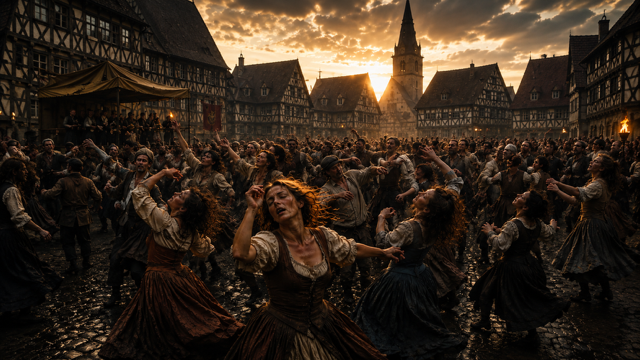
The first great defenestration took place on the 30th of July, 1419, and to understand it you have to go back four years earlier, to a man named Jan Hus. Hus was a Czech priest and reformer who criticised the wealth and corruption of the Catholic Church a full century before Martin Luther made the same argument famous. For his trouble, Hus was lured to the Council of Constance under a promise of safe conduct, declared a heretic, and burned at the stake in 1415.
His death did not silence his followers. It enraged them. The Hussites, as they became known, spread quickly through Bohemia, and tension between them and the Catholic authorities tightened year by year. On that July day in 1419, a Hussite procession led by the radical preacher Jan Želivský marched to the New Town Hall of Prague. They were demanding the release of imprisoned supporters. Someone inside the building, according to the accounts, threw a stone at the crowd.
It was the wrong day to throw a stone. The mob stormed the town hall, seized the judge, the burgomaster, and several town councillors, and threw them from the upper windows onto the street below. Those who survived the fall did not survive the crowd waiting beneath. The shock of the event is said to have been so severe that King Wenceslaus IV, hearing the news, suffered a stroke and died weeks later. With the king dead and the city in open revolt, the Hussite Wars began. They would rage for more than a decade.
What started with a single window became one of the bloodiest religious conflicts medieval Europe had seen.
The Second Fall: 1618 And The Miracle of the Dung Heap
If the first defenestration set a precedent, the second made it legend. On the 23rd of May, 1618, almost exactly two hundred years later, Prague did it again.
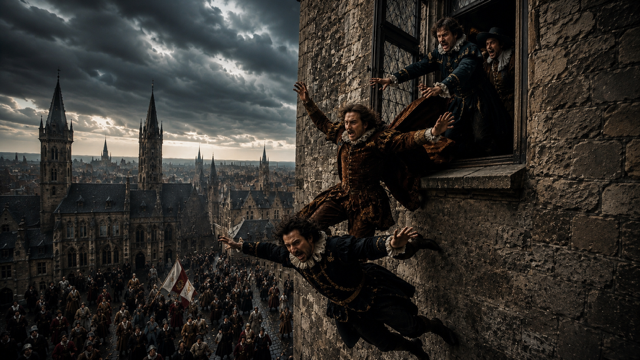
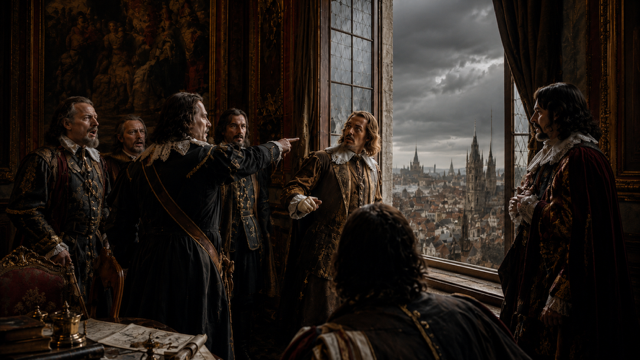
By this point Bohemia was a tinderbox of Protestant and Catholic resentment. Protestant nobles believed their religious freedoms, promised in writing, were being quietly stripped away by the Catholic Habsburg monarchy. A group of them confronted two Catholic imperial governors, Jaroslav Bořita of Martinice and Vilém Slavata of Chlum, in a chamber of Prague Castle. The argument escalated, as arguments in Prague tended to. And then, faithful to the city’s grim tradition, the nobles seized the two governors and their secretary, Philip Fabricius, and threw all three out of the window.
This was no ground-floor scuffle. The men fell roughly seventy feet, around twenty-one metres, from the windows of the Bohemian Chancellery into the castle ditch below. By every reasonable expectation, they should have died.
They did not. All three survived.
What happened next reveals everything about the age. The Catholics declared it a miracle. The men had been saved, they insisted, by the intervention of angels or the Virgin Mary herself, who had cushioned their fall as proof of God’s favour toward the Catholic cause. The Protestants offered a less heavenly explanation. The governors had survived, they said, because they landed in a large pile of manure that had accumulated in the ditch below the window. Divine grace, or a dung heap. The two sides could not even agree on how three men hit the ground.
Whatever broke their fall, the consequences did not soften. The Second Defenestration of Prague triggered the Bohemian Revolt, and the revolt spiralled outward into the Thirty Years’ War, a continent-wide catastrophe that lasted from 1618 to 1648. It drew in nearly every major power in Europe, killed an estimated eight million people through battle, famine, and disease, and left whole regions of central Europe depopulated. Some historians consider it, proportionally, one of the most destructive conflicts in European history.
It began with two men, one secretary, and an open window.
The Third Fall: 1948 and the Man in the Courtyard
The third chapter is the one history still argues about, and it is the one that fits the After Eden spirit best of all, because here the official story and the uncomfortable questions refuse to sit quietly together.
In the early hours of the 10th of March, 1948, Jan Masaryk, the foreign minister of Czechoslovakia and son of the country’s founding president, was found dead in the courtyard of the Czernin Palace. He lay beneath the window of his own bathroom. The Communist government, which had seized full control of the country only weeks earlier, ruled it a suicide. Masaryk, they said, had jumped.
Almost no one fully believed it. Masaryk was one of the last prominent non-Communist figures in the government, a man standing in the way of total Soviet-aligned control. The timing was, to put it gently, convenient. Rumours of murder circulated immediately and never went away.
The case was reopened more than once over the decades that followed. A police investigation concluded in 2004 that Masaryk had not jumped, but had been thrown from the window, a defenestration in the oldest Prague tradition. Forensic studies of the scene raised troubling details about the position of the body and marks in the room. Yet no killer was ever identified, no confession ever produced, and to this day the death of Jan Masaryk sits unresolved between the official record and the suspicions of nearly everyone who has examined it.
It is the kind of mystery that outlives the people who lived it.
Why Prague?
It is tempting to treat this as coincidence, three unconnected events that happen to share a method. But the people of Prague did not see it that way. By 1618, the nobles throwing those governors out of the window knew exactly what they were doing. They were not improvising. They were repeating a ritual, deliberately echoing 1419, sending a message written in the city’s own historical language. Defenestration in Prague was never only an act of violence. It was a statement, a way of declaring that the old order had been judged and cast out.
That is the forgotten truth underneath the morbid humour. These were not random acts of rage. They were moments when ordinary people decided that the authorities above them had lost the right to remain where they stood, and they expressed that judgement in the most literal way imaginable. The window became a verdict.
Prague gave the world a word it never asked for, and three times over it gave that word meaning. The next time you hear it, remember that behind the strange Latin is a city that twice changed the course of European history, and once may have committed a murder, all through the same open window.
These stories survived millennia. A like and follow on our socials through the links below helps make sure they survive the internet too.
Below is a short video from our Youtube channel.
Did you also know about the Erfurt Latrine Disaster? Where 60+ Nobels drowned in 1184 by falling in a latrine pit? Follow this link to read about it.