The Halifax Explosion of 1917: The Largest Blast Before the Atomic Age
On the morning of the 6th of December 1917, the people of Halifax went about an ordinary Thursday. Children dressed for school. Workers filed into the factories and rail yards of the city’s north end. And along the waterfront, as a column of black smoke began to rise from a burning ship in the harbour, people stopped what they were doing and drifted to their windows to watch.
They had no way of knowing that the ship on fire was the most dangerous object on the planet at that moment, or that within minutes their city would be torn apart by the largest explosion human beings had ever produced. Many of those standing at the glass, watching the spectacle, would not survive the next twenty minutes.
This is the story of the Halifax Explosion, a disaster so immense it remained the most powerful man-made blast in history until the atomic bomb, nearly three decades later.
A Harbour Full of War
By 1917 Halifax was one of the most important ports in the British Empire. The First World War had turned its deep, sheltered harbour into a staging ground for the great convoys of ships carrying troops, supplies and munitions across the Atlantic to Europe. The harbour was busy, crowded, and under military control.
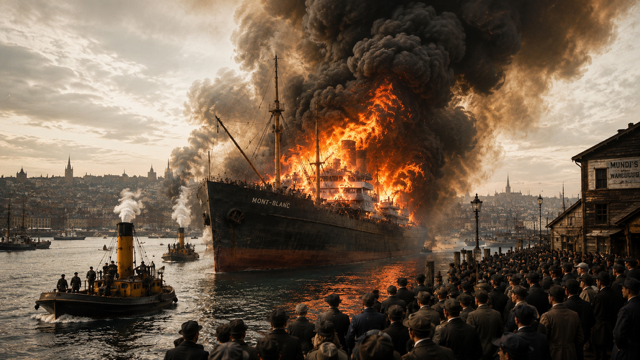
Into this harbour, on that December morning, came the SS Mont-Blanc, a French cargo ship loaded with a cargo of almost unimaginable danger. In her hold sat nearly three thousand tonnes of high explosives, including TNT, guncotton, the volatile motor fuel benzol, and over two thousand tonnes of picric acid, an explosive compound even more sensitive than TNT. In peacetime, a ship carrying such a cargo would never have been allowed into the inner harbour at all. In wartime, the rules had changed.
The Collision
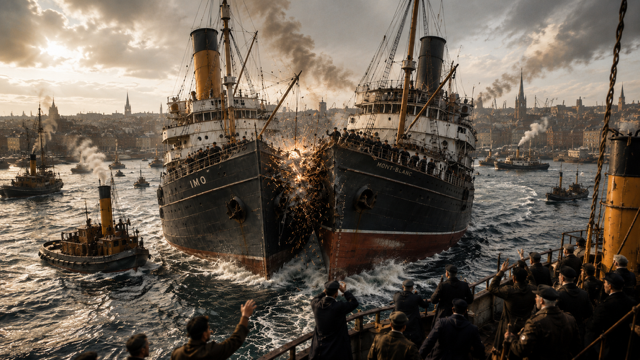
Heading the other way, outbound for New York to collect relief supplies for occupied Belgium, was a Norwegian vessel called the SS Imo. In the narrow channel known as the Narrows, the two ships found themselves on a collision course. Signals were exchanged. Both tried to steer clear. But at the last moment their movements cancelled each other out, and the Imo struck the Mont-Blanc on her bow.
The collision itself was slow and almost gentle. The damage was minor. But the impact threw sparks, and the spilled benzol on the deck caught fire. The crew of the Mont-Blanc, knowing exactly what lay beneath their feet, abandoned ship at once and rowed frantically for the Dartmouth shore, unable to make anyone understand the warnings they shouted in French.
The burning ship, now with no one aboard, drifted slowly across the harbour and came to rest against Pier 6, setting the wooden pier alight. And all the while, the crowds gathered. From the docks, the streets and the windows of the north end, people watched the beautiful, terrible plume of smoke, with no idea that they were looking at a bomb.
Goodbye Boys
In the railway dispatch office at the Richmond yards, just a few hundred feet from the burning pier, a train dispatcher named Vince Coleman was at his post. A sailor ran through warning everyone that the ship was about to explode, and Coleman fled with his colleague.
Then he remembered something. An overnight passenger train, carrying around three hundred people, was due into Halifax within minutes. It would pass directly alongside the burning ship.
Coleman turned around and went back. He sat down at his telegraph key, in the shadow of a floating bomb, and tapped out a final message to stop the incoming train. The wording is remembered as this: “Hold up the train. Ammunition ship afire in harbour making for Pier 6 and will explode. Guess this will be my last message. Goodbye boys.”
He was still at his post when the explosion came. His warning raced down the line, halting trains as far away as Truro, and helping send the first relief trains back toward the ruined city within hours.
Nine Minutes Past Nine
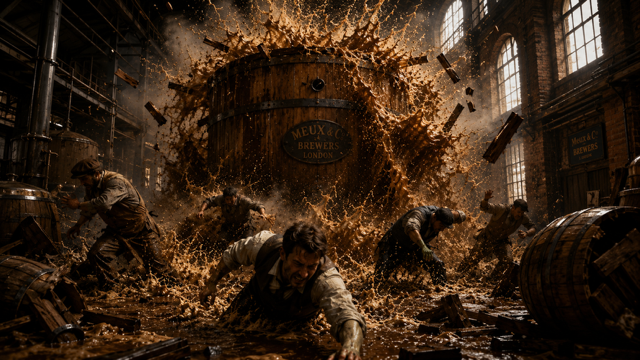
Just after nine o’clock, the fire reached the cargo. In a fraction of a second, the Mont-Blanc ceased to exist. The blast released the energy of roughly three kilotons of explosives and tore through the ship at thousands of metres per second. A piece of the ship’s anchor, weighing over half a tonne, was hurled some three kilometres through the air. The barrel of one of her guns landed miles away.
The shockwave flattened the entire Richmond district. More than sixteen hundred homes were destroyed outright and thousands more were damaged. Every window in the city shattered, and because so many people had been standing at the glass watching the fire, around two hundred of them were permanently blinded by flying shards. The blast was felt and heard hundreds of kilometres away.
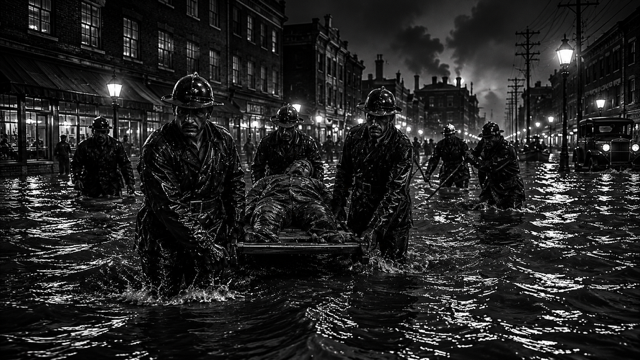
Then came the water. The explosion displaced so much of the harbour that it created a tsunami, a wave rising as high as eighteen metres above the waterline, which surged back over the shore and swept people and buildings away. On the Dartmouth side, the wave destroyed a small Mi’kmaq community at Tufts Cove that had stood there for generations.
By the time it was over, close to two thousand people were dead and around nine thousand injured. And as if the city had not suffered enough, a blizzard struck the very next day, burying the ruins and the survivors under heavy snow.
The Search for a Villain
In the shock that followed, people wanted someone to blame. This was wartime, and the first suspicion fell, predictably, on German spies. Survivors with German names were rounded up. The Norwegian helmsman of the Imo was arrested when a letter was found on him, supposedly written in German. It turned out to be written in Norwegian.
The official inquiry, when it came, laid the blame squarely on the Mont-Blanc, on her captain and pilot and the naval officer in charge of the harbour. It was a tidy verdict, and a convenient one. But it did not hold. A later appeal found what witnesses had seen all along, that both ships had made fatal errors in those final moments in the Narrows, and that responsibility was shared.
The truth was less satisfying than a spy or a single guilty man. There was no saboteur. There was only a floating bomb, allowed into a crowded harbour by the desperate logic of war, and a few seconds of human misjudgement that cost a city almost everything.
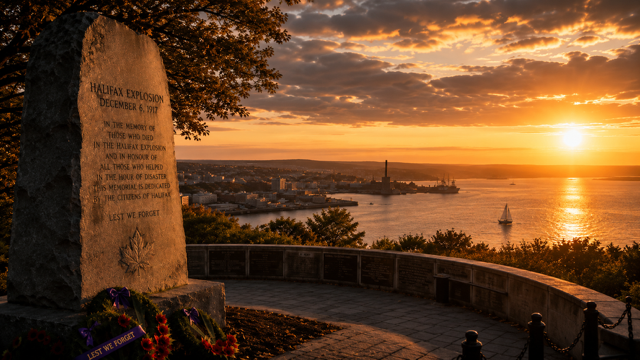
Halifax rebuilt. To this day, every December, the people of Nova Scotia send a Christmas tree to the city of Boston, in thanks for the doctors and supplies that came north through the snow when they needed them most. It is a small, bright gesture, carried across a century, from a city that learned the hard way how quickly an ordinary morning can end.
A short video based off this story on our After Eden Youtube Channel
If you enjoyed this story, you might also like to read all about The Year Without A Summer: How a Volcano Created Frankenstein.
For daily short videos and reels, subscribe or follow us on our socials.
SOURCES
Halifax Explosion, Wikipedia
Vince Coleman (train dispatcher), Wikipedia
The Halifax Explosion, Canadian War Museum
Halifax Explosion National Historic Event, Parks Canada
Vincent Coleman and the Halifax Explosion, Nova Scotia Museum
Halifax Explosion of 1917, Encyclopaedia Britannica
The ‘ordinary man’ who died for strangers when Mont-Blanc exploded, CBC News