The London Beer Flood of 1814: The Day London Drowned in Ale
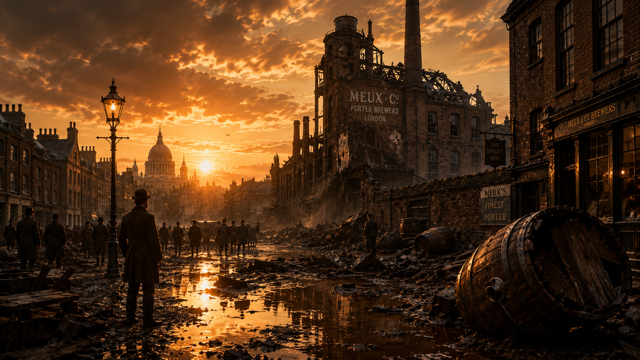
On a Monday afternoon in October 1814, a wall of beer fifteen feet high tore through one of the poorest neighbourhoods in London. It moved faster than a person could run. It flattened houses, swept families out of their beds, and drowned eight people in the streets where they lived. By nightfall, the gutters of St Giles ran with porter, and the air was thick with the smell of it.
This is not a legend. It is one of the strangest industrial disasters in British history, and one of the most quietly damning. Because when the dust settled and the bodies were counted, the men responsible walked away without paying a penny. The court decided that nobody was to blame. God had done it.
The Brewery That Built Monsters
The Horse Shoe Brewery stood at the corner of Great Russell Street and Tottenham Court Road, owned by Meux and Company. In the early nineteenth century, London brewers were locked in a strange arms race, and the weapon was size. The bigger the fermentation vat, the greater the prestige. Brewers competed to build the largest wooden tanks anyone had ever seen, towering structures bound together by iron hoops, some holding the equivalent of thousands of barrels at once.
Meux had one of the giants. Standing twenty-two feet tall and filled with months-old fermenting porter, it was held together by enormous iron rings, one of them weighing several hundred pounds on its own. It was a cathedral of beer, and it sat directly behind the cramped tenements of the St Giles rookery, a slum so notorious it was a byword for poverty and overcrowding.
Whole families lived in single cellar rooms below street level. They had no idea they were living in the shadow of a flood.
The Warning That Was Ignored
On the afternoon of 17 October 1814, a brewery storehouse clerk named George Crick noticed something wrong. One of the iron hoops around the great vat had slipped. This had happened before. Hoops slipped all the time, and nothing ever came of it, so Crick did what the brewery always did. He noted it down and sent word to one of the partners, expecting it to be repaired in due course. It was routine. It was nothing.
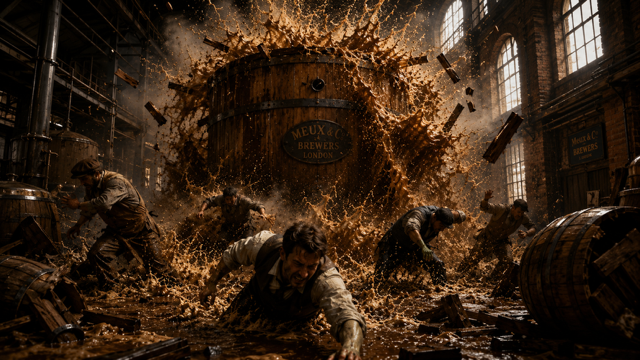
About an hour later, at roughly half past five, the vat exploded.
The rupture released the hot, fermenting ale with such violence that the vat burst into splinters and the entire back wall of the brewery collapsed. The blast set off a chain reaction. The force knocked the valve clean off a neighbouring vessel and shattered several more vats, each one dumping its contents into the growing torrent. In moments, somewhere between one hundred and twenty thousand and well over three hundred thousand imperial gallons of beer surged out into the street. The most commonly cited figure is over three hundred and twenty thousand gallons, more than a million litres of porter, released all at once.
The back wall of the brewery was two and a half bricks thick. The flood did not just break it. It launched bricks through the air, hurling them onto the roofs of houses nearly a mile away.
Fifteen Feet Of Beer
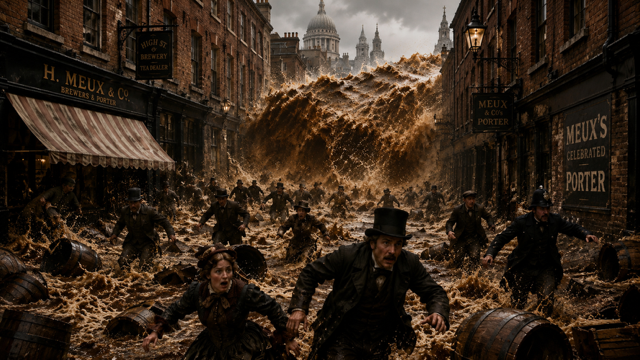
The wave rolled into the narrow lanes of St Giles and swallowed everything. It demolished two houses entirely. It poured into cellars where families lived, filling them in seconds. There was nowhere to climb, no warning, no time.
In a basement room on New Street, a group of Irishwomen had gathered for a wake. They were mourning a two-year-old boy who had died the day before, sitting with his body as was the custom, waiting for the men to return from their labouring jobs. The beer found them where they sat. Five of the eight people killed that day were at that wake, including the dead child’s own mother.
Upstairs in the same building, a woman named Mary Banfield was having tea with her four-year-old daughter Hannah. Both were killed. Nearby, fourteen-year-old Eleanor Cooper was washing pots at an outdoor pump behind a public house when the wall came down on her. The dead ranged in age from three years old to sixty-five. Their names were Eleanor Cooper, Mary Mulvey, Thomas Murray, Hannah Banfield, Sarah Bates, Ann Saville, Elizabeth Smith and Catherine Butler. Most of them were women and children. All of them were poor.
An Act of God
Two days later, a coroner’s inquest was held at the St Giles workhouse. The coroner took the jury to view the wrecked brewery and then to view the bodies. They heard testimony from Crick and others. They learned about the slipped hoop, the routine that had failed, the warning that had gone unanswered.
And then they returned their verdict. The eight victims, they decided, had died “casually, accidentally and by misfortune.” The disaster was ruled an unavoidable act of God. No one was responsible. No one would pay.
This is the part of the story that should sit uneasily. A vat had been known to be faulty. A hoop had slipped and been noted. The scale of the danger was a direct result of brewers chasing prestige by building tanks far larger than anyone could safely contain. None of that was an act of God. It was a chain of human choices, made by men who would never live in a cellar. But in the early industrial age, the law had little appetite for punishing progress, and even less interest in the lives of the urban poor.
The families who lost everything received nothing. Meux and Company, meanwhile, did far better. The company claimed losses of around twenty-three thousand pounds, a fortune at the time, and successfully petitioned Parliament for a refund on the excise tax it had already paid on the beer it lost. That waiver saved the brewery thousands of pounds and very likely saved it from bankruptcy. The company that drowned eight people was made whole. The neighbourhood it drowned was not.
The Grim Afterlife Of The Flood
What happened next is almost too bleak to believe. With the families destitute, some relatives put the bodies of the victims on public display, charging a small fee to view them in the hope of raising money. In one house, so many curious visitors crowded in to see a corpse that the floor gave way beneath them, plunging the whole crowd waist-deep into a cellar still flooded with beer.
The stench of porter hung over St Giles for months. There is a persistent, unconfirmed story that one man died of alcohol poisoning days later after drinking too much of the free beer, though no record confirms it. It may be true. It may simply be the kind of dark joke a disaster like this attracts.
The Horse Shoe Brewery went back into production and stayed open for more than a century, finally closing in 1921 and being demolished the following year. Today the Dominion Theatre stands partly on the site, where audiences watch musicals above the ground where eight people once drowned in beer. In the years that followed, the giant wooden vats that had been a brewer’s pride were quietly phased out across the industry, replaced by lined concrete. No one ever called it an apology.
The London Beer Flood is usually told as an oddity, a punchline, the day a city of pubs was swamped by its favourite drink. But underneath the absurdity is something colder. Eight people died because of how their world was built, and the world that built it decided that was nobody’s fault at all.
A short video from our Youtube Channel about the beer flood
If you found this story interesting, you might also like to know about The Great Molasses Flood of 1919. It was the day that Boston drowned in Syrup.