The Green Children Of Woolpit: The Medieval Mystery Never Solved.
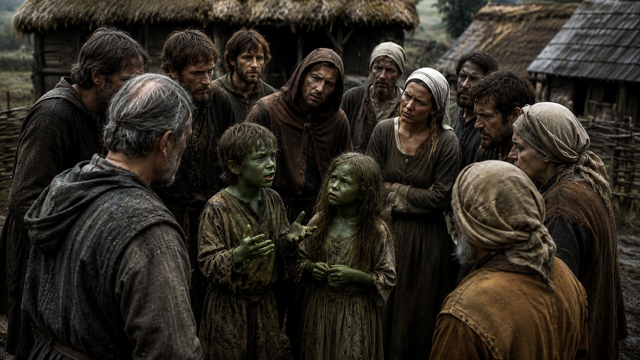
Sometime in the twelfth century, in a quiet farming village in the east of England, two children appeared at the edge of a field. A boy and a girl, lost and frightened, standing where moments before there had been no one at all. The villagers who found them could not understand a word they said. Their clothes were strange. Their language was unknown. And their skin was green.
Not pale. Not sickly. Green, the colour of the fields around them.
This is the story of the Green Children of Woolpit, and it is one of the most enduring mysteries of medieval England. It comes to us not as a whispered legend but from the pens of two respected chroniclers of the age, men who wrote it down as something that had truly happened. Nearly nine hundred years later, we still cannot say with certainty who those children were, where they came from, or how they came to stand green skinned and bewildered at the edge of an English field.
A Discovery at the Wolf Pits
The village was Woolpit, in Suffolk. Its name is thought to come from the wolf pits, the deep trenches dug nearby to trap wolves, which still roamed the English countryside in those days. It was at the mouth of one of these pits, during the harvest, that the reapers found them.
A boy and a girl, both with green skin, stood crying near the trench. The villagers, astonished, gathered round and tried to speak to them, but the children answered only in a language no one recognised. They were taken to the home of a local landowner, a knight named Sir Richard de Calne, who took them in.
But the children would not eat. Bread was offered to them and they refused it. Meat, the same. They seemed on the edge of starving, surrounded by food they would not touch, until by chance some freshly cut bean stalks were brought into the house. The children seized them at once. They tore the stalks open looking for the beans inside, and finding the stalks empty, they wept again. When they were shown how to open the pods properly and find the beans within, they ate hungrily. For a long time afterwards, broad beans were the only food they would accept.
The Boy Who Faded Away
The two children did not fare equally in their new world. The boy, who appeared to be the younger of the two, grew weak. He had never been well since the day they were found, and as the weeks passed he sickened further. Before long he died, and was buried, having never fully adjusted to the food or the world he had been thrown into.
The girl was made of sterner stuff. Slowly, she adapted. As she began to eat a wider variety of food beyond her beloved beans, something remarkable happened. The green colour faded from her skin. Bit by bit, the strange tint drained away until she looked like any other child in the village, and her once unnatural appearance became ordinary.
She was baptised into the Christian faith and remained in the household, growing up among the people of Woolpit. And as she learned to speak English, she was finally able to answer the question that everyone had been asking since the day she was found. Where had she come from?
Her answer only deepened the mystery.
The Place With No Sun
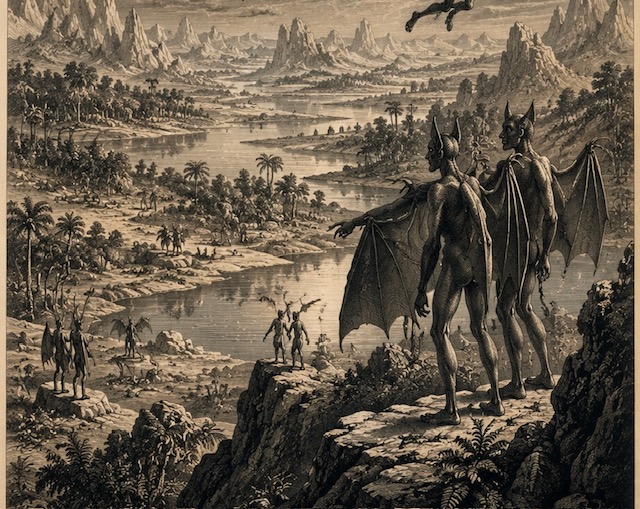
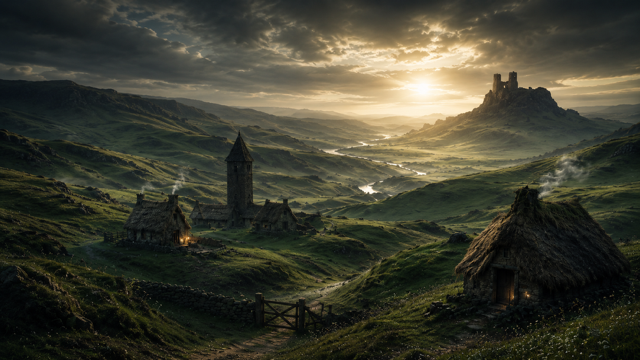
The girl described a homeland she called Saint Martin’s Land. It was a place, she said, where everyone was green skinned as she had been, and where the sun never shone as it did here. Instead, her country lay in a kind of permanent twilight, a perpetual dim glow like the light that lingers after the sun has set. Beyond a wide river, she said, lay another bright and shining land that they could see across the water but could not reach.
As for how she and the boy had come to England, her account was just as strange. They had been tending their father’s herds, she explained, when they followed the animals into a cavern. Inside, they heard the sound of bells, a beautiful, ringing sound that drew them deeper underground. They wandered through the darkness for a long time, following that sound, until at last they emerged, blinking and disoriented, into the dazzling sunlight of a Suffolk afternoon. The brightness overwhelmed them. And before they could find their way back, they were discovered by the reapers, lost and unable to return the way they had come.
The girl, by all accounts, lived on for many years. She took the name Agnes, found work, and eventually married. Some accounts describe her as having lived a perfectly ordinary life, the last living trace of an event no one could explain.
So Who Were They?
For centuries, the Green Children of Woolpit have hovered between two worlds, half fairy tale, half history. To some, the story is pure folklore, a tale of fairy children from an underground realm, the kind of legend medieval England told to make sense of the strange and the unexplained. The bells, the twilight land, the cavern that swallows travellers, all of these echo the old folk beliefs about the otherworld that lay just beneath the surface of the everyday.
But others have looked for a more earthly explanation, and there is a theory that fits the facts with surprising neatness.
In the twelfth century, large numbers of Flemish immigrants had settled in eastern England, and they were not always welcome. There was persecution, and at times violence. Some historians suggest the Green Children may have been the orphaned offspring of Flemish settlers, perhaps left without parents after one of the bloody episodes of the period. This would explain a great deal. Their unknown language would have been Flemish, unfamiliar to the Suffolk villagers. There is even a place not far away once known as Fornham Saint Martin, which could lie behind the girl’s Saint Martin’s Land.
And the green skin? That too has a possible answer. There is a condition once known as the green sickness, a severe form of anaemia caused by poor diet and malnutrition, which can give the skin a pale greenish tinge. Two starving, orphaned children, surviving on whatever they could find, might well have developed it. And as the surviving girl began to eat properly, her health would have recovered, and the green colour would have faded away, exactly as the chronicles describe.
The cavern, the bells, the journey through the dark, these could be the confused memories of frightened, traumatised children, or the embellishments of storytellers retelling the tale across the generations.
A Mystery That Will Not Fade
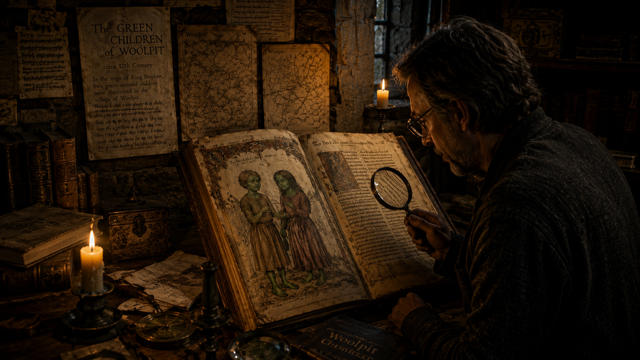
We will probably never know the full truth. The two chroniclers who recorded the story, Ralph of Coggeshall and William of Newburgh, were writing of events from their own era, treating it as genuine history rather than fable. That is part of what makes the Green Children of Woolpit so haunting. It is not a story that comes to us through the mists of myth alone. It comes from men who believed it was real.
Perhaps they were lost immigrant children, casualties of a cruel age, their strangeness explained away by hunger and language and fear. Or perhaps something stranger happened in that field beside the wolf pits, something that even the careful chroniclers of the day could not fully grasp.
Either way, two green children walked out of the dark and into history. And nearly nine hundred years later, we are still standing at the edge of that field, wondering where they came from.
A short video from our After Eden Youtube Channel about this story.
If you enjoyed this story, you might like to read about The Day Niagara Falls Stopped: The 1848 Mystery That Silenced The Falls.
Follow us on our socials for daily reels and shorts on the social links below.