Violet Jessop: The Women Who Survived Three Shipwrecks
Some people seem to have all the luck in the world. Others seem to attract disaster wherever they go. Violet Jessop somehow managed to be both at once. She stood on the decks of the three greatest ocean liners ever built by the White Star Line, and she watched two of them sink beneath her and the third nearly torn apart. Each time, against all odds, she walked away alive.
They called her Miss Unsinkable. By the end of her life she had earned the title many times over. This is the remarkable true story of the woman who survived three shipwrecks, and lived to tell every one of them.
A Life That Began Against The Odds
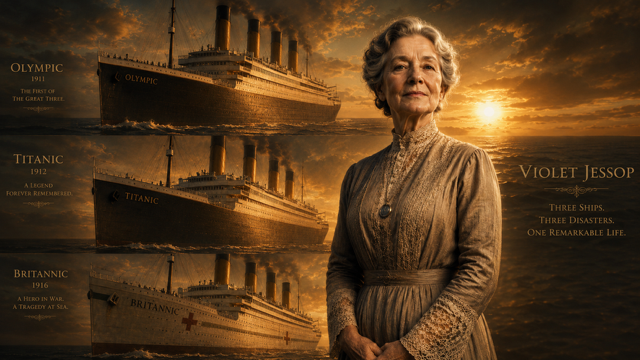
Violet Constance Jessop was born in 1887 in Argentina, the eldest child of Irish immigrant parents who had crossed the world in search of a better life. From the very beginning, survival was something she had to fight for. As a young girl she contracted tuberculosis, a disease that killed millions in that era, and doctors gave her only a few months to live. She refused to die. She recovered fully, the first of many times she would defy the expectations of everyone around her.
Her early life was not easy. After her father died, the family moved to England, and her mother took work as a ship’s stewardess to keep the household afloat. When her mother’s health failed, the responsibility of supporting her younger brothers and sisters fell on Violet’s shoulders. Still only a teenager, she left her convent schooling behind and followed her mother to sea, taking a job as a stewardess aboard the great ocean liners of the day.
It was demanding work, long hours tending to the needs of wealthy passengers, but it offered a steady wage and a chance to see the world. Violet was good at it. She was warm, capable, and resilient. She had no way of knowing that the ships she served would carry her straight into history.
The First Warning: RMS OLYMPIC
In 1911, Violet was working aboard the RMS Olympic, the largest civilian ship in the world at the time and the pride of the White Star Line. The Olympic was the first of three enormous sister ships, all built to the same magnificent design. The second would be called the Titanic. The third would be named the Britannic. Violet, by extraordinary chance, would serve aboard all three.
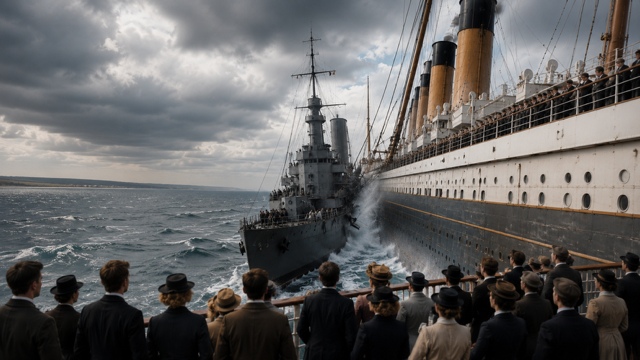
On the twentieth of September 1911, as the Olympic was leaving harbour off the Isle of Wight, disaster struck. A British warship, HMS Hawke, collided with the giant liner, tearing a hole in her hull. It was a serious accident, and it could easily have been catastrophic. But the Olympic stayed afloat, limping back to port with everyone aboard safe.
For Violet, it was a frightening brush with danger, but nothing more. She had survived her first maritime disaster, and she returned to her work without much fuss. The sea, it seemed, was not finished with her yet.
The Night The Titanic Sunk
Less than a year later, Violet found herself assigned to the Olympic’s famous sister ship. In April 1912, she boarded the RMS Titanic as a stewardess for its maiden voyage, joining a vessel that the world had been told was practically unsinkable.
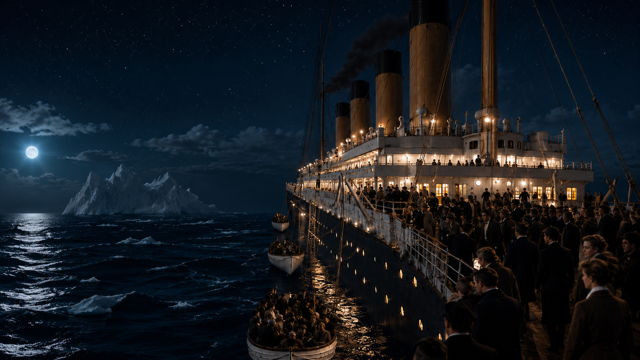
On the night of the fourteenth of April, the Titanic struck an iceberg in the freezing North Atlantic. Violet, like the rest of the crew, was caught up in the chaos that followed. As the great ship began to founder, she was ordered up onto the boat deck, where she was held up as an example to the non English speaking passengers, showing them by her calm how to behave as the lifeboats were loaded.
Eventually she was placed into a lifeboat herself. As she climbed in, an officer handed her a baby to hold. She took the child and clutched it close as the lifeboat was lowered down the towering side of the dying ship and out onto the black water. From there she watched the unthinkable happen, as the largest moving object ever built by human hands slid beneath the waves, taking more than fifteen hundred souls with it.
Violet and the baby were among the survivors picked up by the rescue ship Carpathia. According to her own account, once aboard, a woman rushed up to her, snatched the baby from her arms without a word, and disappeared into the crowd. She assumed it was the child’s mother, reunited at last. She never saw either of them again.
She had now survived two disasters aboard the White Star Line’s sister ships. There was one ship left.
The Britannic And The Propellers
By 1916, the world had changed. The Great War was raging, and the third and final sister ship, the Britannic, had never carried a single fare paying passenger. Instead she had been converted into a hospital ship, painted white with great red crosses on her sides, carrying the wounded across the Mediterranean. And Violet Jessop, ever drawn to the sea, was aboard her as a nurse.
On the twenty first of November 1916, the Britannic was steaming through the Aegean Sea near the Greek island of Kea when a violent explosion ripped through her hull. She had struck a mine laid by a German submarine. Water poured in, and the mighty ship, even larger than the Titanic, began to sink, and far faster.
In the panic, lifeboats were launched before the order was given, and two of them were drawn straight into the ship’s enormous propellers, which were still turning as the stern rose out of the water. The boats and the people in them were torn apart. Violet was in one of those boats. Realising what was about to happen, she leapt into the sea to save herself, and was promptly sucked underwater toward the churning blades.
She was dragged beneath the surface and struck her head hard against the keel of the ship as she passed beneath it. By her own later account, it was her thick hair, piled up beneath her, that cushioned the blow and saved her skull from being crushed. She survived, was pulled from the water, and lived to count her third shipwreck.
Years afterward, she remembered grabbing one small thing before fleeing the Britannic, a toothbrush, joking that not having one after the Titanic had been the thing she missed most.
Miss Unsinkable
After three brushes with death aboard three sister ships, most people would never have set foot on the water again. Violet Jessop was not most people. She returned to sea and continued working aboard ocean liners for decades, eventually sailing around the world twice and serving with other shipping lines well into later life. The sea had tried three times to claim her, and three times it had failed.
She finally retired to a quiet cottage in the English countryside, in the county of Suffolk, where she lived out her remaining years far from the waves. She died in 1971, at the age of eighty three, having outlived not only three sinking ships but most of the people who had ever doubted she would survive.
There is a story that long after the Titanic, Violet received a mysterious telephone call from a woman claiming to be the very baby she had saved that night. Whether it was true or simply a friend playing a trick, no one can say for certain. But it is a fitting footnote to a life that always seemed to dance on the edge of the impossible.
Violet Jessop began her life given only months to live. She went on to survive one of history’s most famous disasters, then a second, then a near miss with a third. Miss Unsinkable, they called her. The name could not have been more deserved.
A short video on this story on our After Eden Youtube channel.
If you enjoyed this story, you might be interested in reading about Ancient Roman Fast Food and the amazing street food culture frozen in time.
If you would like to see daily shorts and reels, feel free to follow us on our socials below.