

The Carrington Event: The Solar Storm That Could End Modern Civilisation
On the morning of the 1st of September 1859, a quiet English astronomer sitting in his private observatory in the small town of Redhill, Surrey, was doing what he did most mornings. He was carefully sketching the sunspots on the surface of the sun. His name was Richard Carrington. He had no idea he was about to witness something that had never been seen before in recorded history, and that the event he was about to observe would one day become the benchmark for one of the greatest threats facing modern civilisation.
Without warning, two brilliant white flares of extraordinary intensity erupted from a large cluster of sunspots. They blazed so brightly that Carrington was momentarily blinded. Within minutes they had faded. He noted the time, made his records, and went to find a fellow astronomer to confirm what he had seen. But by the time he returned, the flares had already vanished.
What Carrington could not see was what had been launched toward Earth in those few blinding minute, a colossal cloud of magnetised plasma, hurled across 150 million kilometres of space at extraordinary speed. It would arrive in less than 18 hours. And when it did, the world would never look at the sun quite the same way again.
The Night the Sky Caught Fire
In the early hours of the 2nd of September 1859, the most powerful geomagnetic storm in recorded history struck Earth’s magnetic field. The effects were immediate, dramatic, and in some cases genuinely terrifying.
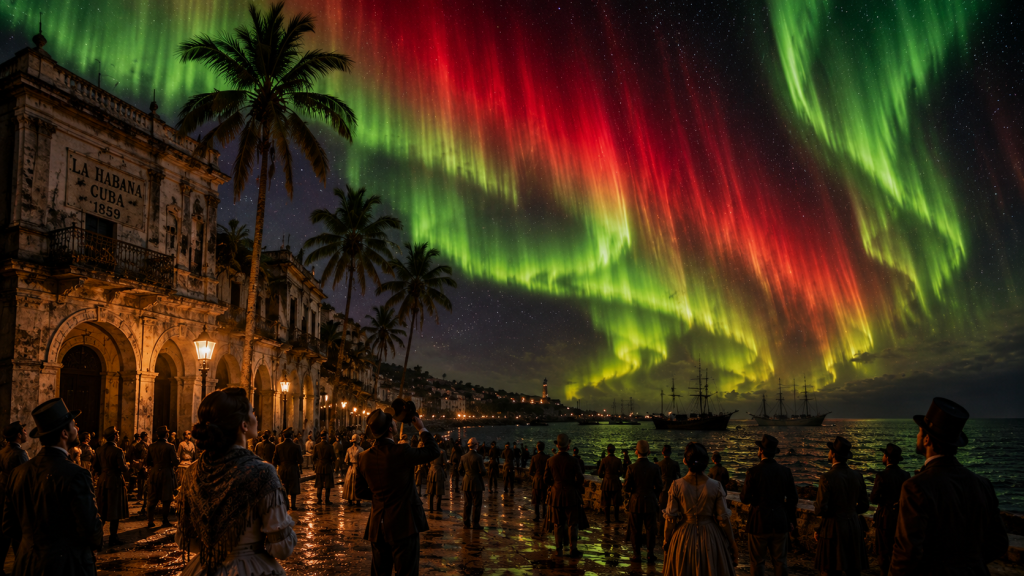
Across the world, skies that should have been dark blazed with colour. Auroras which are the natural light displays usually confined to the polar regions erupted across latitudes where they had never been seen before. In the northeastern United States, the aurora was so bright that people woke in the night believing it was dawn. Miners in the Rocky Mountains got up and began making breakfast. Birds started singing. In Cuba, the Caribbean, and even parts of South America, vivid crimson and green lights filled the sky. People who had never seen an aurora and had no framework to understand it fell to their knees in prayer, convinced the end of the world had arrived.
But it was what happened on the ground that truly announced the scale of what had struck the planet. In 1859, the most advanced communications technology in the world was the telegraph. A global network of wires and electrical signals that historians have called the Victorian Internet. And the Carrington Event tore through it with devastating force.
Telegraph operators across Europe and North America reported that their equipment had gone haywire. Sparks flew from machines. Operators received electric shocks. In some stations, the paper rolls used to record incoming messages caught fire. One telegraph manager in Pittsburgh reported that the currents flowing through the wires were so powerful that the platinum contacts were in danger of melting, with what he described as streams of fire pouring from the equipment.
Most astonishingly of all, some telegraph operators discovered that they could disconnect their machines entirely from their power sources and keep sending messages anyway. The geomagnetic storm itself was generating enough electrical current in the wires to power the network. The sun was running the telegraph system on its own terms.
Who Was Richard Carrington?
Richard Carrington was not a professional astronomer in the institutional sense. He was a wealthy amateur and a brewer’s son who had built his own private observatory and dedicated himself to the meticulous observation and sketching of sunspots. He had been tracking them for years with exceptional care and precision.
When the flare occurred on the morning of the 1st of September, Carrington did something that would prove to be one of the great moments of scientific insight in history. He connected what he had seen on the surface of the sun with what happened to the Earth’s magnetic field less than 18 hours later. He proposed that the solar flare had caused the geomagnetic storm and that the sun and the Earth were connected in ways nobody had previously understood.
This was a genuinely radical idea at the time. The connection between solar activity and disruption on Earth had never been formally established. Carrington was essentially describing, from first principles and a single observation, what we now call space weather. His name has been attached to the event ever since and to the entire field of understanding that grew from it.
How Big Was It, Really?
The Carrington Event was not just the largest geomagnetic storm in the roughly 150 years of reliable instrumental records. Ice core samples drilled from the polar regions — which preserve chemical signatures of past solar activity going back thousands of years — suggest it was approximately twice as powerful as any other solar storm in the last 500 years. It was, in every measurable sense, an extraordinary outlier.
The coronal mass ejection that caused it is estimated to have carried the energy equivalent of ten billion atomic bombs. It crossed the distance between the sun and the Earth in approximately 17 and a half hours — a journey that a typical coronal mass ejection takes two to three days to complete. It hit fast, hard, and with a ferocity that the planet’s magnetic field had almost certainly not experienced in centuries.
The Near Miss of 2012
Here is where the story stops being merely historical and becomes urgently relevant.
In July 2012, a coronal mass ejection of Carrington-class intensity was detected by NASA’s STEREO-A spacecraft. Scientists who later analysed the data concluded it was every bit as powerful as the 1859 event and possibly more so. It was a full solar superstorm, travelling at extraordinary speed through space.
It missed Earth by approximately nine days of orbital motion.
Had the eruption occurred just one week earlier, our planet would have been directly in its path. The storm passed through the precise region of space that Earth occupies in its orbit around the sun. We were not there. By the slimmest of margins, the 21st century avoided what could have been the most catastrophic technological disaster in human history.
What Would Happen Today?
In 1859, the most sophisticated electrical infrastructure on Earth was the telegraph network. The damage was dramatic but ultimately recoverable. Today, the picture is almost incomprehensibly different.
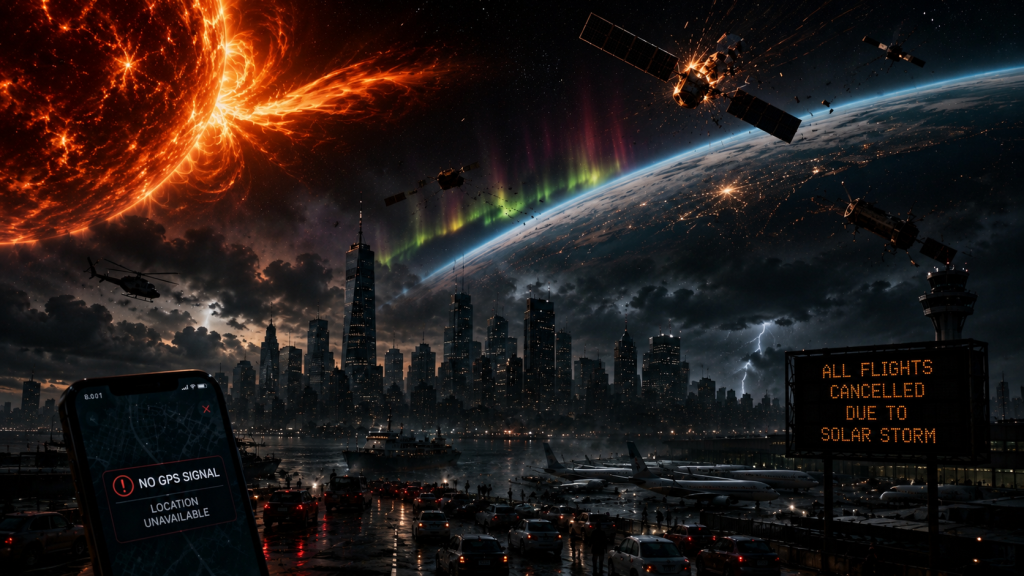
Modern civilisation runs on electricity and electronics. Power grids. Satellites. GPS systems. Banking infrastructure. Communications networks. Aviation. The internet. All of it is vulnerable to a geomagnetic storm of Carrington magnitude, and some of it is profoundly vulnerable.
A 2008 report from the National Academy of Sciences estimated that a Carrington-scale event today could cause damage costing between one and two trillion dollars in the United States alone. A Lloyd’s of London risk assessment put the figure even higher, at up to 2.6 trillion dollars for the US, with between 20 and 40 million people facing extended power outages lasting anywhere from 16 days to one to two years.
The reason the recovery would take so long comes down to a single critical vulnerability: high-voltage transmission transformers. These enormous pieces of equipment are the backbone of national power grids. They are not mass produced. They take months or years to manufacture. They cannot be quickly replaced. A Carrington-class storm could damage or destroy significant numbers of them simultaneously, across multiple countries, leaving entire regions without power for extended periods while the world scrambled to rebuild infrastructure it was never designed to replace quickly.
Satellites in low Earth orbit would face severe disruption. GPS systems, which underpin not just navigation but financial transactions, telecommunications timing, and aviation. All of them could fail. The geomagnetically induced currents that flow through the ground during a major storm can disrupt pipelines, rail networks, and any infrastructure with long conductive elements.
Scientists estimate the probability of a Carrington-class event occurring within the next decade at somewhere between one and ten percent. That range sounds wide, but even at the lower end it is not a remote risk. It is a serious, quantifiable, recurring natural hazard and one that happens to be invisible until it is already upon us.
The Legacy of a Morning’s Observation
Richard Carrington died in 1875, sixteen years after his extraordinary observation. He lived long enough to see his connection between solar flares and geomagnetic storms gradually accepted by the scientific community, though full understanding of the mechanisms involved would take another century to develop.
What he left behind was more than a name attached to a historical event. He left behind the foundational insight of space weather science. He left the understanding that the sun is not a distant, passive backdrop to life on Earth but an active, dynamic, and occasionally ferocious presence whose behaviour directly shapes conditions on our planet.
The Carrington Event remains the benchmark. The standard against which all other solar storms are measured. The worst case scenario that every space weather agency on Earth plans around. And the quiet reminder, written in fire and auroral light across the sky of September 1859, that the universe does not particularly care how sophisticated our technology becomes.
The sun was here long before the power grid. And on the right morning, with the right eruption pointed in the right direction, it could remind us of that in ways we would not soon forget.

