Roman Fast Food: The Incredible Street Food Culture Frozen in Time at Pompeii
Culture Frozen in Time at PompeiiImagine walking through a busy city street, the smell of spiced wine and roasting meat drifting through the air, and stopping at a stone counter to grab a quick lunch before heading back to work. It sounds like any modern city on any given Tuesday.
But this scene played out not in a contemporary food market. It played out in ancient Rome, two thousand years ago. And thanks to one of history’s most catastrophic volcanic eruptions, we know it in extraordinary, almost unbelievable detail.
A City Frozen in Time. On the morning of the 24th of August, 79 AD, Mount Vesuvius which is a volcano looming over the Bay of Naples in southern Italy erupted with terrifying force. The eruption lasted over 24 hours and buried the thriving Roman city of Pompeii under metres of volcanic ash and pumice.
Somewhere between 2,000 and 15,000 people perished. The city simply ceased to exist, swallowed whole by the mountain.
But here is the extraordinary twist that makes Pompeii one of the most important archaeological sites on Earth. The same volcanic material that killed the city also preserved it. Sealed under ash for nearly 1,700 years,
Pompeii was effectively frozen in a single moment of time. When excavations began in earnest in the 18th century, archaeologists found not ruins in the traditional sense, but a city with streets, buildings, artwork, tools, food, and human remains. All preserved in astonishing detail.
It is the closest thing the ancient world has ever given us to a time machine. And among the most vivid and relatable things they found were the fast food restaurants.
Enter the Thermopolium The ancient Roman fast food counter was called a thermopolium, from the Greek words meaning “a place where something hot is sold.” The plural is thermopolia, and in Pompeii alone, archaeologists have identified over 80 of them.
In a city of perhaps 11,000 people, that works out to roughly one fast food stall for every 100 residents. Rome, it turns out, was a city that loved eating out.
A thermopolium was built into the front of a building, facing the street. The counter was typically made of masonry, stone or concrete with large ceramic jars called dolia sunk directly into its surface.
These jars held prepared food and drinks, kept warm throughout the day. Customers would walk up, point to what they wanted, and eat either standing at the counter or in a small back room with benches.
It was, in every meaningful sense, the ancient world’s version of a takeaway counter or street food stall.
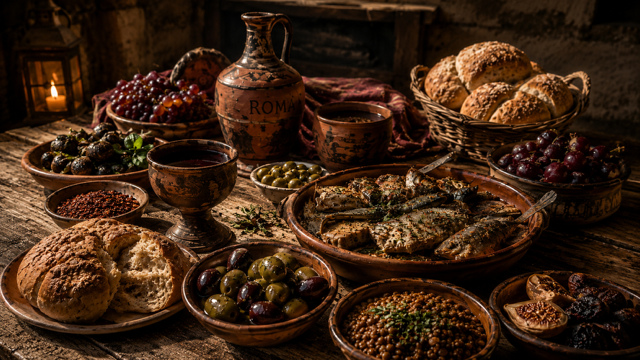
The menus were practical and filling. Across the thermopolia of Pompeii, archaeologists have found evidence of bread, lentils, salty fish, baked cheese, and spiced wine. Some stalls sold olives, nuts, and chickpeas. Others offered more substantial dishes involving meat.
It was affordable, convenient food for people on the move and it tells us something genuinely fascinating about who was eating it and why.
Fast Food Was for the Working Class
Here is something that feels almost the wrong way around to modern eyes. In ancient Rome, eating out was not a luxury. It was largely something the poor did out of necessity. The wealthy classes dined at home, reclining at elaborate banquets prepared by enslaved household workers in richly decorated dining rooms.
Eating at a street counter was considered a distinctly lower-class affair, associated with labourers, traders, and those who simply could not afford the space or fuel to cook at home.
Many ordinary Romans lived in apartment buildings called insulae which were multi-storey blocks that were often cramped, poorly built, and at serious risk of fire. Cooking facilities in these dwellings were limited or non-existent.
For the average working Roman, the thermopolium was not a novelty. It was lunch.
This gives the thermopolia of Pompeii a particular kind of poignancy. They are not monuments to Roman power or wealth. They are monuments to ordinary life and to the daily routines of ordinary people going about their day, grabbing a bite to eat, stopping to talk with neighbours, sharing a cup of wine after work. In that sense they feel startlingly close to us.
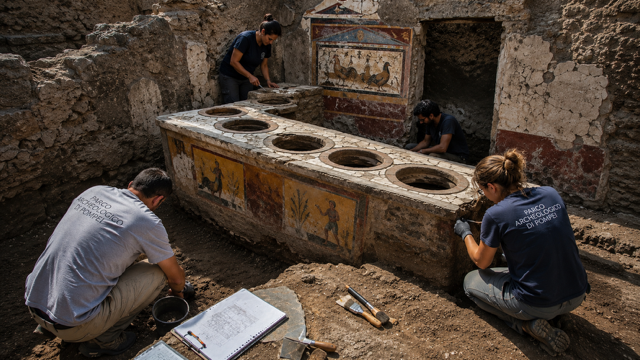
The Remarkable Discovery of Regio V Pompeii has been yielding extraordinary finds since the first major excavations of the 18th century, but in December 2020 archaeologists announced a discovery that made headlines around the world. In an area of the site called Regio V which is a 54-acre section that has been the focus of the most extensive excavation work since the 1960s where they uncovered a thermopolium in a state of preservation that was almost impossible to believe.
The counter was decorated with vivid, beautifully detailed frescoes, paintings that depicted a mallard duck, a rooster, a dog on a leash, a sea nymph riding a seahorse, and two amphorae. These images were not merely decorative.
The paintings of the duck and the rooster almost certainly served as a visual menu, advertising to passing customers, including those who could not read explaining exactly what meats were available that day. It was ancient advertising, painted directly onto the counter.
Inside the dolia, food remains were still present. Scientific analysis identified fragments of duck bone, pig bone, goat, fish including tuna, and snails. Wine residue was found in one of the jars. A bronze drinking bowl, a flask containing fava beans, and clay storageamphorae were recovered nearby.
The fresco paintings and the food remains matched and the images on the counter depicted the very ingredients that were being served.
Alongside the thermopolium, archaeologists also found something more sobering. The skeletal remains of a man believed to be in his fifties were discovered within the structure, along with the bones of a small dog.
They died where they stood, caught by the eruption before they could flee. The last day of business at this particular stall ended not with closing up the shutters but with the sky turning black and the mountain tearing itself apart.
What It Tells Us About the Romans
It is easy to think of the ancient Romans as distant and alien and toga-clad figures from marble friezes, separated from us by centuries of history and mythology. The thermopolia of Pompeii collapse that distance in a way that almost nothing else can.
These were people who grabbed lunch on the way to work. Who lingered over a cup of wine and argued about the chariot races. Who had their regular stall, their preferred vendor, their usual order.
The thermopolium was not just a food counter. It was a social hub. Neighbours met there. Deals were done. Gossip was exchanged. Life happened around those stone counters in ways that would feel entirely familiar to anyone who has ever lingered at a coffee shop or a street food market today.
The decorated counters also speak to something deeply human. The desire to make your business attractive, to stand out, to draw people in. The owners who could afford elaborate frescoes invested in them because they worked, because presentation mattered, because customers responded to a welcoming and visually appealing stall.
Two thousand years separate us from those decisions, and yet they make perfect sense. The Volcano That Preserved the Truth. There is a profound irony at the heart of Pompeii’s story. The catastrophe that killed the city is also the reason we know it so well.
Without Vesuvius, the thermopolia would have crumbled over centuries, their frescoes faded, their food remains long since decomposed. The wooden signs, the serving vessels, the last meals of the day? All of it would be gone. The eruption that ended thousands of lives also accidentally created the most detailed portrait of Roman daily life that has ever been found.
Every new excavation at Pompeii adds another layer to that portrait. Regio V continues to yield discoveries, new structures, new skeletons, new glimpses into the final hours of a city that had no idea what was coming.
Archaeologists estimate that roughly a third of Pompeii is still unexcavated. The mountain buried so much, and so much of it is still waiting to be found.
What has already emerged is extraordinary enough. The Romans had fast food, vibrant street life, clever advertising, and a culture of eating out that would feel recognisable today. They were, in so many ways, far more like us than we tend to imagine.
And thanks to one terrible morning in 79 AD, we can see that truth written in volcanic ash, painted in vivid frescoes, and preserved in the ancient remains of duck and tuna sitting in a stone counter on a Pompeii street.
The menu has not changed as much as we think.
If you enjoyed history from Rome, you might also Like to read about The Library of Alexandria and its destruction.
Feel Free to visit us and subscribe to daily videos on our socials links below.