The Erfurt Latrine Disaster: When 60 Nobles Drowned in 1184
History is full of grand tragedies. Battles lost, cities burned, empires undone by ambition. And then there is the Erfurt Latrine Disaster, an event so undignified that for centuries people assumed it had to be a joke.
It was not. On a summer morning in 1184, dozens of the most powerful men in the Holy Roman Empire gathered in one room to make peace, and within minutes the floor opened beneath them and dropped them into a pit of human waste. Most of them did not climb out.
It is one of the strangest deaths in recorded history, and like so many forgotten truths, the real story is far more troubling than the punchline suggests.
A Kingdom Held Together By Meetings
To understand how this happened, you have to picture what power looked like in the twelfth century. The Holy Roman Empire was not a tidy nation with clear borders and a single ruler giving orders. It was a vast, restless patchwork of princes, bishops, dukes, and landgraves, each guarding their own slice of territory and each quick to take offence. Holding it all together required constant negotiation.
The man trying to do the holding in 1184 was Henry VI, son of the famous emperor Frederick Barbarossa. Henry was still young, somewhere around eighteen, and he was acting on his father’s authority while Barbarossa was occupied elsewhere. A serious quarrel had broken out between two important figures. On one side stood Conrad of Wittelsbach, the Archbishop of Mainz. On the other stood Ludwig III, the Landgrave of Thuringia. The exact cause is uncertain, but it almost certainly came down to land and the rights that came with it, the usual fuel for medieval feuds.
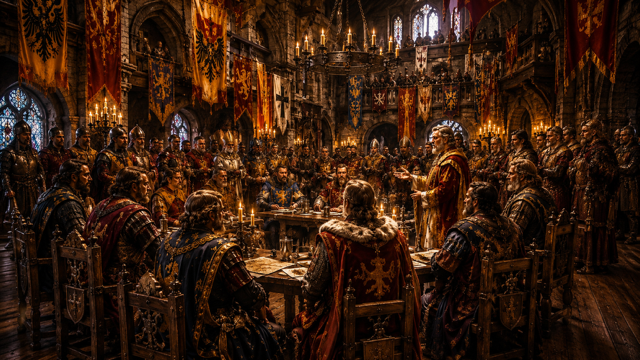
Rather than let the dispute fester into open conflict, Henry called a Hoftag. This was a formal assembly of the realm, a kind of royal court day where the king would sit in judgement, hear grievances, and impose a settlement. Nobles travelled from across the region to attend. It was meant to be a display of order and authority. Instead, it became a warning about the limits of both.
The Gathering in Erfurt
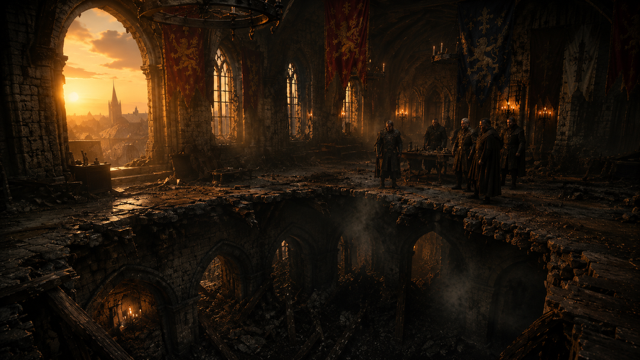
The assembly was held in Erfurt, a thriving town in what is now central Germany, in a building beside the cathedral, most likely connected to the deanery or the church complex on the hill. On the twenty-sixth of July, the room filled with men. Kings, archbishops, counts, and their attendants pressed into an upper chamber, all of them robed, many of them armoured, all of them heavy with the weight of their station and their gear.
And this is where an ordinary detail of medieval life turned deadly. Beneath that upper floor lay the building’s latrine system, and it was no modest arrangement. Monastic and church buildings of this kind often built enormous cesspits, deliberately oversized so they would not need emptying for years at a time. Waste from the upper levels dropped down chutes into a deep, vaulted chamber below, where it collected and decayed in the dark.
So beneath this room full of standing, shifting noblemen sat a pit that had been quietly filling for a very long time. The wooden floor between the two was never built to hold a crowd of this size. It was built for a few people walking through. On that July day it was asked to do far more than it could.
The Collapse
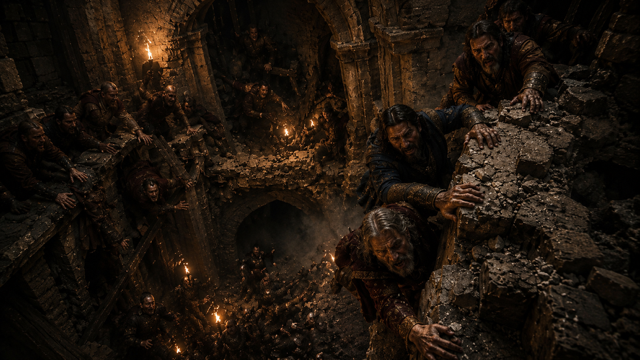
There was no warning. According to the accounts that survive, the floor simply gave way. The beams cracked, the boards split, and the entire assembled crowd dropped through. Some sources suggest they crashed through the ground floor as well before reaching the cesspit beneath, which meant a fall through two storeys for many of them.
What waited below was worse than the fall. The pit was deep, deeper in places than the height of a man, and it was full. The waste had the consistency of something between liquid and quicksand, thick enough to pull a person down and impossible to swim through. Men in heavy clothing, stunned by the drop and tangled with one another and with falling debris, found themselves sinking in it.
The deaths came in several forms. Some were killed outright by the fall or crushed by the timber and stone that came down with them. Others drowned in the filth, unable to find purchase or keep their heads above the surface. And some, it is said, were overcome by the fumes rising off years of decay, suffocating before help could reach them. Estimates of the dead vary between roughly sixty and a hundred. Sixty noble deaths can be confirmed with reasonable confidence, which makes it one of the deadliest accidents of its kind in the medieval record.
The King On The Windowsill
There is one detail in this story that reads almost like a parable, and the remarkable thing is that it appears to be true.
Henry VI did not fall. At the moment the floor collapsed, the young king was seated in a stone window alcove, a recess built into the thick masonry of the outer wall. Stone does not fall the way a wooden floor does. The alcove held. The Archbishop of Mainz, Conrad, is said to have been there with him, and he too was spared. The two men clung to the stone and waited, suspended above the carnage below, until rescuers arrived with ladders and brought them safely down.
Landgrave Ludwig of Thuringia, one of the two men whose quarrel had caused the whole gathering, did fall into the collapse. Yet he survived and was pulled out. In a final twist worthy of the darkest humour, all three of the central figures who had brought everyone together that day lived, while many of the nobles summoned to witness their reconciliation perished in the pit.
The Aftermath and the Silence
There was no grand reckoning. Henry VI did not linger to mourn or to finish the business he had come for. He left Erfurt almost immediately and returned to the military campaign that had been interrupted to bring him there. The dispute between the archbishop and the landgrave, the very reason for the assembly, was left unresolved.
The dead were buried quickly, many of them in mass graves. In the summer heat, with the scale of the loss and the risk of disease, there was little choice. The estates and titles of the fallen passed to brothers, sons, and daughters, and the slow machinery of inheritance ground on.
Among the named dead were nobles such as Heinrich of Schwarzburg and Gozmar III, men whose lines and lands were rerouted in an instant by a structural failure no one had thought to fear.
Chroniclers recorded the event, sometimes with a grim flatness that still unsettles. One scribe listed the important men who had drowned and then closed, almost coldly, with a note that others had died too. The disaster was real, it was documented, and it was largely forgotten, perhaps because it sat so uncomfortably between horror and absurdity that later ages did not know how to hold it.
Why It Still Matters
It is tempting to treat the Erfurt Latrine Disaster as a medieval curiosity, a gross footnote to be passed around for shock value. But there is something more sober underneath it. These were powerful men, secure in their authority, gathered to demonstrate control over their world. None of that mattered when the floor failed. Status offered no protection. The most ordinary feature of the building, its plumbing, undid them all.
It is a reminder that history does not always end with the dramatic stroke we expect. Sometimes the great are brought low not by armies or assassins but by a beam that could not bear the load. The men who walked into that room in Erfurt believed they were shaping the future of an empire. Instead they left behind one of the most strangely human lessons the past has to offer.
If this story has stayed with you, you might pass it on. These accounts survived more than eight hundred years of silence. Sharing them is how they survive the next eight hundred.
If you liked this article, you may also like to read The War of the Bucket, where These Two Nations Started a War Over a Bucket!