The Dancing Plague of 1518: The Deadly Outbreak History Can’t Explain.
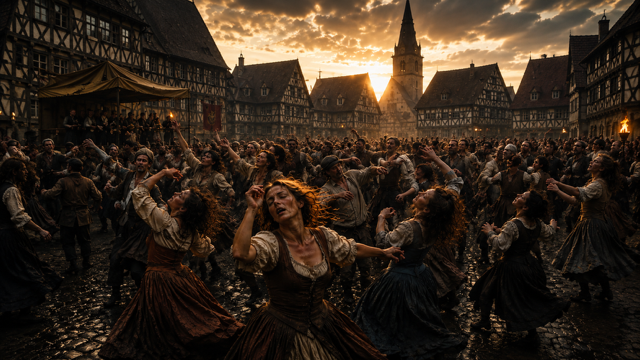
In the summer of 1518, in the city of Strasbourg, a woman walked into a narrow street and began to dance. There was no music. There was no festival. There was no reason anyone could see. She simply danced, alone, in front of her neighbours, and she did not stop.
Her name was Frau Troffea, and she would dance for nearly a week without rest. Her feet bled. Her body trembled with exhaustion. And still she danced, as though something inside her had taken control and would not let go. By the time she finally collapsed, she was no longer alone. Dozens of others had joined her in the street, caught in the same silent, relentless motion. Within a month, the number had grown to around four hundred people. And some of them would dance until they died.
This is the Dancing Plague of 1518. It is not a legend. It is not a myth dressed up as history. It is one of the best documented mysteries of the medieval world, recorded by physicians, city councillors, and the chronicles of the time. And five hundred years later, we still cannot fully explain what happened.
A City That Could Not Stop Moving
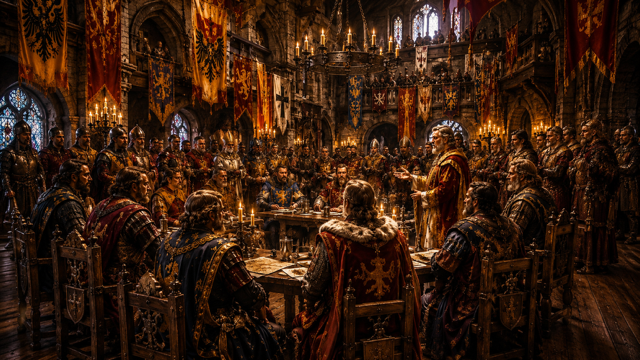
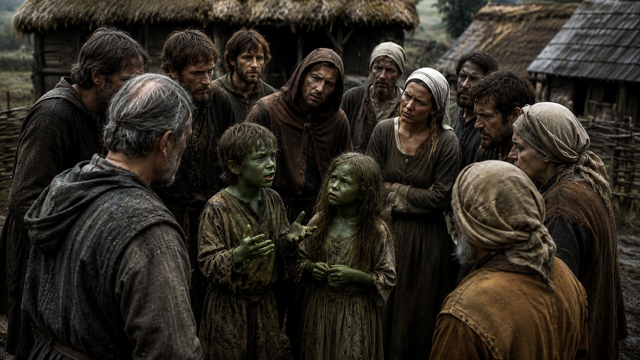
Strasbourg in 1518 was a city already living under a shadow. It sat in the region of Alsace, then part of the Holy Roman Empire, and the years leading up to that summer had been brutal. Failed harvests had brought famine. Disease moved through the crowded streets, including smallpox and the terrifying new sickness that would come to be called syphilis. The poor were desperate, the future uncertain, and a deep spiritual dread hung over daily life. People believed that suffering was a punishment, and that worse was always coming.
It was into this exhausted, frightened city that Frau Troffea stepped and began to dance.
What unsettled the people who watched her was not just that she danced, but that she could not seem to choose otherwise. Her face showed no joy. This was not celebration. It looked far more like torment. And whatever had taken hold of her, it spread.
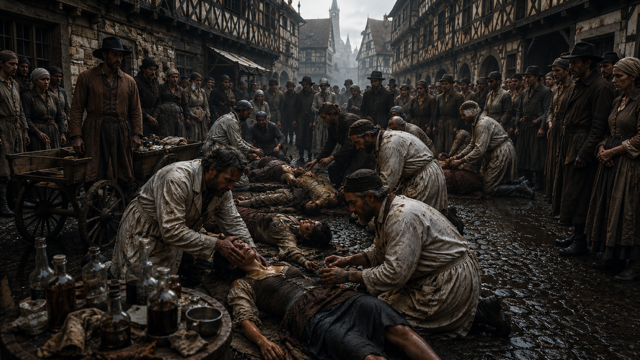
Within days, more than thirty others were dancing alongside her. The number climbed week by week. The afflicted moved through the streets and squares of the city, twitching, leaping, spinning, their bodies pushed far beyond what should have been possible. Contemporary accounts describe people dancing for days at a time, until they dropped from heart attacks, strokes, or sheer exhaustion. One chronicle suggests that at the height of the outbreak, as many as fifteen people were dying every day.
The Cure That Made It Worst
Faced with hundreds of citizens dancing themselves to death, the authorities of Strasbourg did something that seems almost unthinkable now. They decided that the cure for the dancing was more dancing.
The reasoning, strange as it sounds, followed the medical thinking of the age. Physicians of the time concluded that the affliction was caused by overheated blood, and that the only way to break the fever was to let the victims dance it out of their bodies. So the city leaned in. They cleared open spaces. They opened guild halls. They built a wooden stage. They even hired musicians and professional dancers to keep the rhythm going, in the belief that the sufferers needed to dance until they were free of it.
The result was a catastrophe. Rather than burning out, the epidemic grew. More music drew more dancers. More dancers drew more onlookers, some of whom were swept into the movement themselves. The city had effectively poured fuel onto the fire and then wondered why it spread.
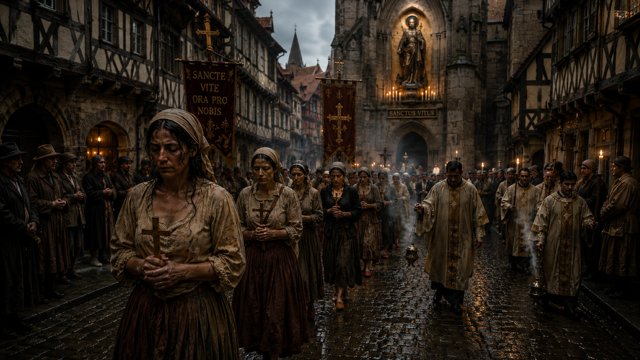
Only when the deaths mounted did the authorities change course. The dancing was banned. The afflicted were gathered and taken out of the city, up into the mountains to a shrine dedicated to Saint Vitus, the saint believed to hold power over the dancing curse. There, they were given red shoes and led through rituals meant to lift the affliction. And eventually, as mysteriously as it had begun, the dancing faded away.
So What Really Happened?
This is where the Dancing Plague stops being a story and becomes a genuine puzzle. Because we have the records. We know it happened. What we do not have is an explanation that everyone agrees on.
One of the most popular theories points to a poison. Ergot is a toxic mould that grows on damp rye, and the bread of the poor in 1518 would often have been made from exactly that grain. Ergot contains compounds related to LSD, and poisoning by it, known as ergotism or Saint Anthony’s Fire, can cause violent convulsions, hallucinations, and a burning sensation in the limbs. On the surface, it seems to fit a city full of people thrashing and shaking in the streets.
But there is a serious problem with the ergot theory. The same poison also constricts blood vessels and cuts off circulation to the arms and legs, often leading to gangrene. It is very hard to imagine someone in the grip of that kind of poisoning being physically able to dance, in coordinated movement, for days on end. Ergotism tends to leave its victims unable to move at all, not driven to dance.
The explanation that many historians now find more convincing is something far stranger and, in a way, far more human. It is the idea of mass psychogenic illness, sometimes called mass hysteria. The historian John Waller, who has studied the event in depth, argues that the dancing was a kind of collective stress reaction. A population pushed to the edge by famine, disease, and fear, steeped in a culture that genuinely believed an angry Saint Vitus could strike people with an uncontrollable dance, entered a state where that belief became physically real. In a trance brought on by extreme distress and total conviction, the body did what the mind feared it would.
In other words, they danced because, deep down, they believed they had to.
Not The Only Time
What makes the Dancing Plague even more haunting is that 1518 was not unique. Outbreaks of so-called dancing mania had been recorded in Europe for centuries before, often along the rivers Rhine and Mosel. One of the largest struck the city of Aachen in 1374, where crowds of people reportedly danced through the streets in the same uncontrollable way. The pattern repeated, again and again, in communities under strain, bound together by shared belief and shared terror.
These episodes belong to a world we no longer fully understand, a world where the line between the spiritual and the physical was thin, and where fear could move through a crowd like a fever.
The Dancing Plague of 1518 survives because people at the time wrote it down. They saw something they could not explain, and they recorded it faithfully, leaving us a mystery we still turn over five hundred years later. It is a reminder that the human mind, under enough pressure and enough belief, is capable of things that look very much like the impossible.
They danced until they could not stand. And to this day, no one can tell us for certain why.
A short video explaining the dancing plague on our After Eden Youtube channel
If you enjoyed this article, you might also be interested in reading about the Beer Flood of 1814 which occurred in London when a large vat exploded.
If you would like to follow us on our socials, the links are below.