The Great Moon Hoax of 1835: The Bat-Men That Fooled the World
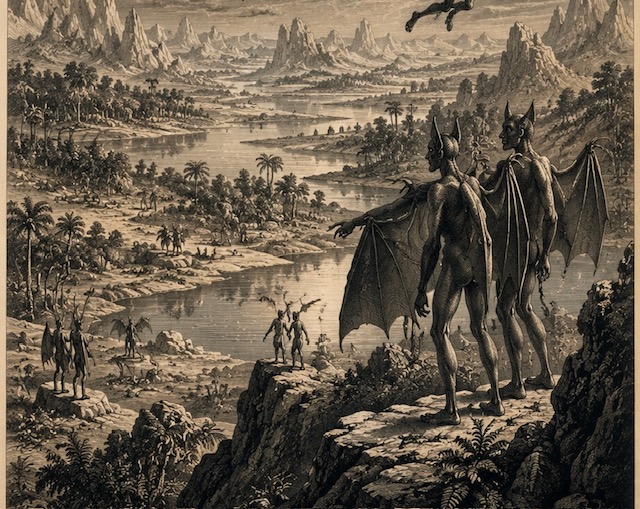
In the last week of August 1835, the people of New York opened their newspaper and learned, in calm and confident prose, that life had been discovered on the Moon. Not microbes. Not moss. Forests and oceans, herds of bison, blue unicorns, beavers that walked upright on two legs, and, gliding through the lunar valleys on wings of leathery skin, a race of intelligent winged people. Bat-men.
It sounds like the plot of a penny novel, and in a sense it was. But it was printed as fact, attributed to one of the most respected scientists of the age, and devoured by a public that, for the most part, believed every word. This is the story of the Great Moon Hoax, one of the earliest and most spectacular pieces of fake news ever published, and a reminder that the appetite to believe is far older than the internet.
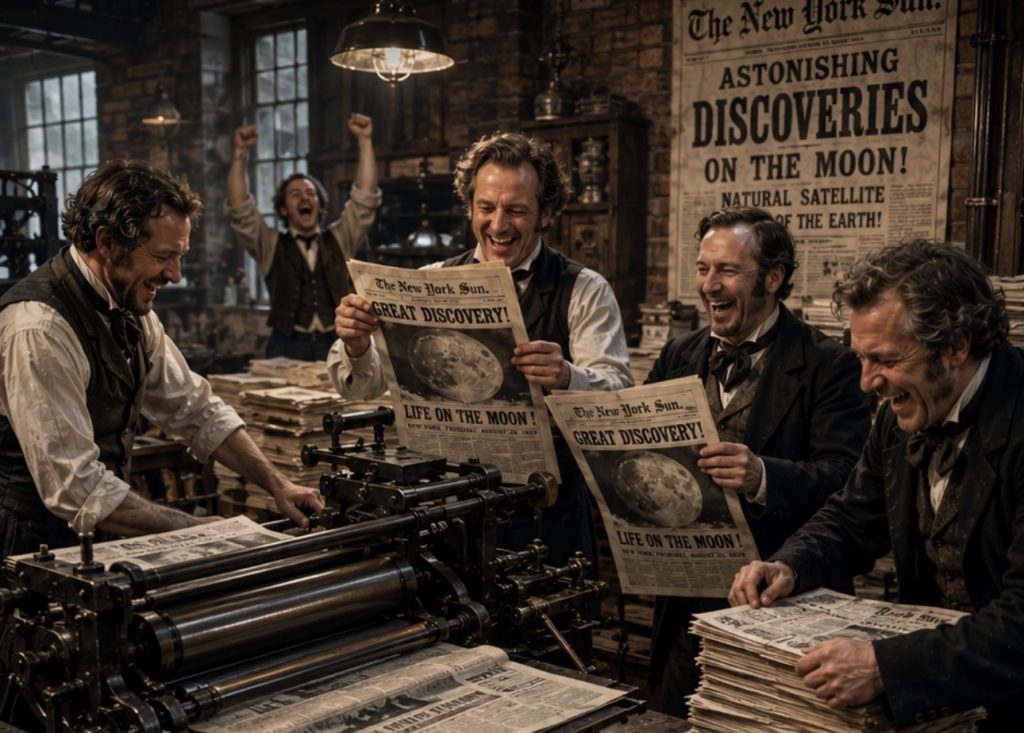
A Newspaper Hungry for Readers
The paper was The Sun, a New York daily barely two years old. It was a penny paper, cheap enough for ordinary working people, and it survived on sensation, on fires and murders and scandal, the louder the better. Before the Moon story, it was selling around eight thousand copies a day and being outsold by most of its rivals. It needed something extraordinary.
What it ran, beginning on the 25th of August, was a series of six articles describing astonishing discoveries supposedly made by Sir John Herschel, the most famous astronomer of his day. The detail was clever. Herschel was real, and he really had travelled to the Cape of Good Hope in South Africa to study the southern skies. He was thousands of miles away, unreachable, and in no position to deny anything. The articles claimed to be reprinted from the Edinburgh Journal of Science, lending them the weight of a respected scientific publication.
The Discoveries
According to The Sun, Herschel had built a telescope of an entirely new design, an instrument so powerful it could magnify the Moon as though it lay only a hundred yards away. Through it, the articles said, he had settled the greatest question in science. The Moon was alive.
The discoveries grew bolder with each instalment. First came lush vegetation, forests and inland seas and white beaches. Then animals, miniature bison, goats with a single horn, small zebras, and tailless beavers that walked on two legs, carried their young in their arms, and built huts with fire. There were cliffs studded with sapphires and a temple of polished sapphire, its roof held up by columns.
And then, in the fourth article, came the creatures everyone remembers. Herschel had supposedly seen humanlike beings flying across the lunar landscape on broad, bat-like wings. He named them Vespertilio-homo, the man-bat. They were, the article gushed, of great personal beauty, scarcely less lovely than painters’ visions of angels, and they were clearly intelligent, for they had been observed in conversation with one another.

A City Spellbound
The effect was sensational. Circulation soared, and The Sun was soon claiming to be among the most widely read papers in the world. Rival newspapers, unwilling to be left behind, simply reprinted the story as their own, and so the man-bats spread across the United States and then across the ocean to Europe.
Most people, it seems, believed it. At Yale, students and professors eagerly awaited each new instalment. A group of Yale scientists, hunting for the original Edinburgh Journal articles, travelled all the way to The Sun’s offices in New York, where staff sent them back and forth between the printing room and the editorial room until they gave up and went home, never realising they had been played. Religious groups began earnestly debating how missionaries might bring the gospel to the people of the Moon. The writer Edgar Allan Poe, watching it all unfold, observed that not one person in ten doubted the story, and noted with dismay that a professor of mathematics had told him in all seriousness that he had no doubt of its truth.
The Cracks Appear
The hoax carried within it the seeds of its own undoing, for those sharp enough to notice. The Edinburgh Journal of Science, the very publication the articles claimed to quote, had in fact ceased publication two years earlier, in 1833. It could not possibly have printed anything in 1835.
There was also the convenient matter of the telescope. To explain why no further observations would be forthcoming, the articles reported that the great instrument had been destroyed, the Sun’s rays passing through its enormous lens like a burning glass and setting the entire observatory on fire. It was an ending almost too tidy to be true.
It was a rival paper, the New York Herald, that finally pulled the thread, pointing out the impossible journal citation and naming the likely author. The Sun, for its part, quietly admitted the articles were fabricated in mid September, though it never printed a proper retraction. Sir John Herschel, when word at last reached him in Africa, was amused at first, remarking that it was a shame his real discoveries would never be half so exciting. His amusement did not last. He later complained of being pestered from every quarter about the ridiculous hoax, in English, French, Italian and German.
The Man Behind the Moon
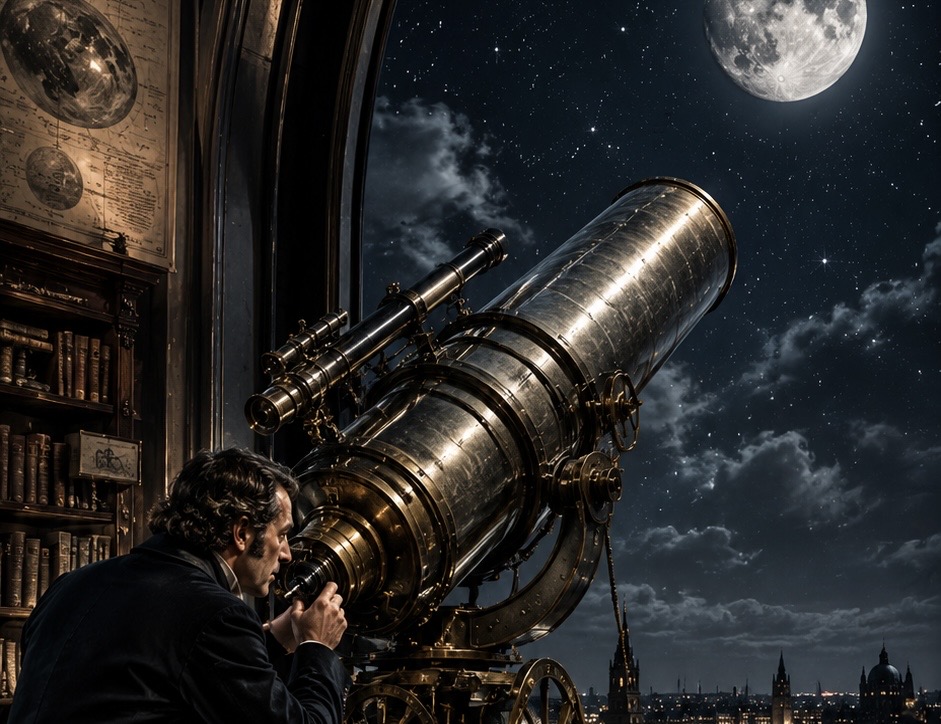
The author was almost certainly Richard Adams Locke, a Cambridge-educated British writer working as an editor at The Sun. His motives appear to have been twofold. The first was simple and commercial, to sell newspapers, which it did beyond anyone’s expectations. The second was stranger and more interesting. Locke had intended the whole thing as satire.
His target was a popular school of thought that claimed the heavens were teeming with life. Writers like the Scottish minister Thomas Dick had earnestly calculated that the Moon alone was home to billions of inhabitants, all part of a universe brimming with souls. Locke meant to mock this extravagant blending of science and wishful belief by pushing it to an absurd extreme. The trouble was that his satire was too well made. Instead of laughing, people simply believed it. A parody designed to expose how easily science could be bent by what people wished to be true ended up proving exactly that, in the most literal way imaginable.
The man-bats never existed. But the thing the hoax revealed, the speed with which a confident story, dressed in the borrowed authority of a trusted name, can race around the world before the truth has finished tying its shoes, has never gone away. We simply gave it new machines to
A short video about this article from our After Eden Youtube Channel.
If you enjoyed this article, you might also be interested in reading about The Nephilim: Giants, Fallen Angels or Something Far Darker?
For daily short videos, visit us on our social links below.
SOURCES
Great Moon Hoax, Wikipedia
The Great Moon Hoax of 1835 Was Sci-Fi Passed Off as News, Encyclopaedia Britannica
“The Great Moon Hoax” is published in the New York Sun, History.com
How the Sun Conned the World With “The Great Moon Hoax”, JSTOR Daily
Richard Adams Locke, Linda Hall Library
The Great Moon Hoax (1835), Hoaxes.org
Belief, Legend, and the Great Moon Hoax, Library of Congress (Folklife Today)