The Bodies Beneath Easter Island
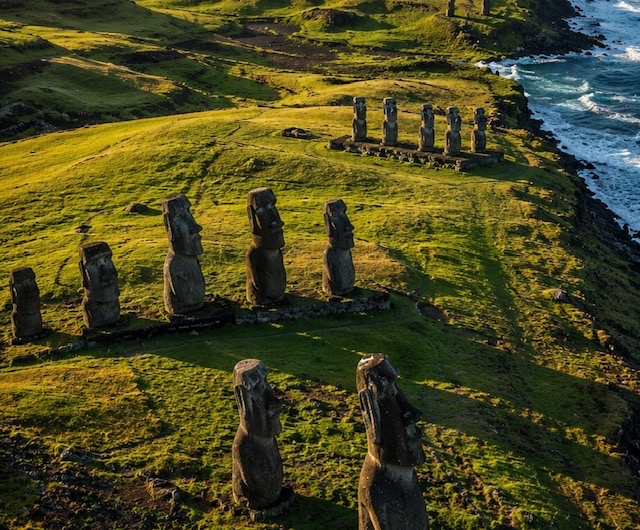
For most of the modern world, Easter Island means one image. A row of colossal stone faces, severe and weathered, staring out across the grass of a remote Pacific speck. We call them the Easter Island heads, and the name has stuck so firmly that it has become a small act of misunderstanding repeated by millions of people who have never questioned it.
Because they are not heads.
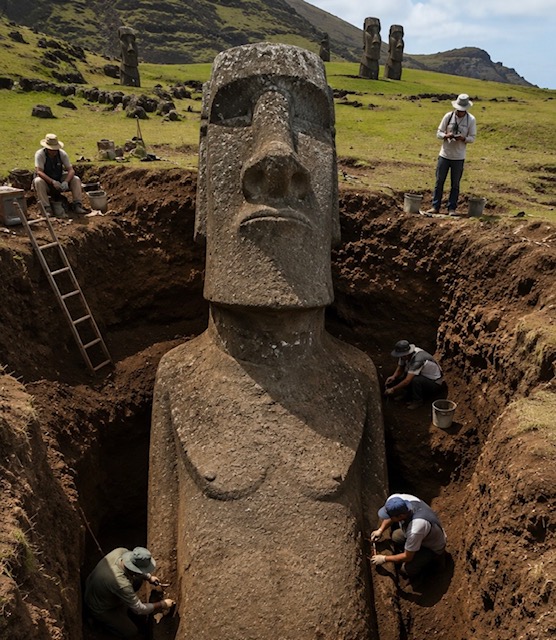
The figures the world knows as heads are whole bodies. Beneath the soil, hidden from every postcard and travel poster, the moai of Rapa Nui have shoulders, torsos, arms and hands, carved in low relief with long slender fingers curving toward the stomach. The reason almost nobody pictures them this way is simple. For centuries the only moai left standing were the ones on the slopes of a volcanic quarry called Rano Raraku, and those statues had been slowly swallowed by the ground around them. Sediment washed down the hillside. Dust settled. Season after season the earth crept up the carved stone until only the great heads remained above the surface, watching a landscape that had buried the rest of them.
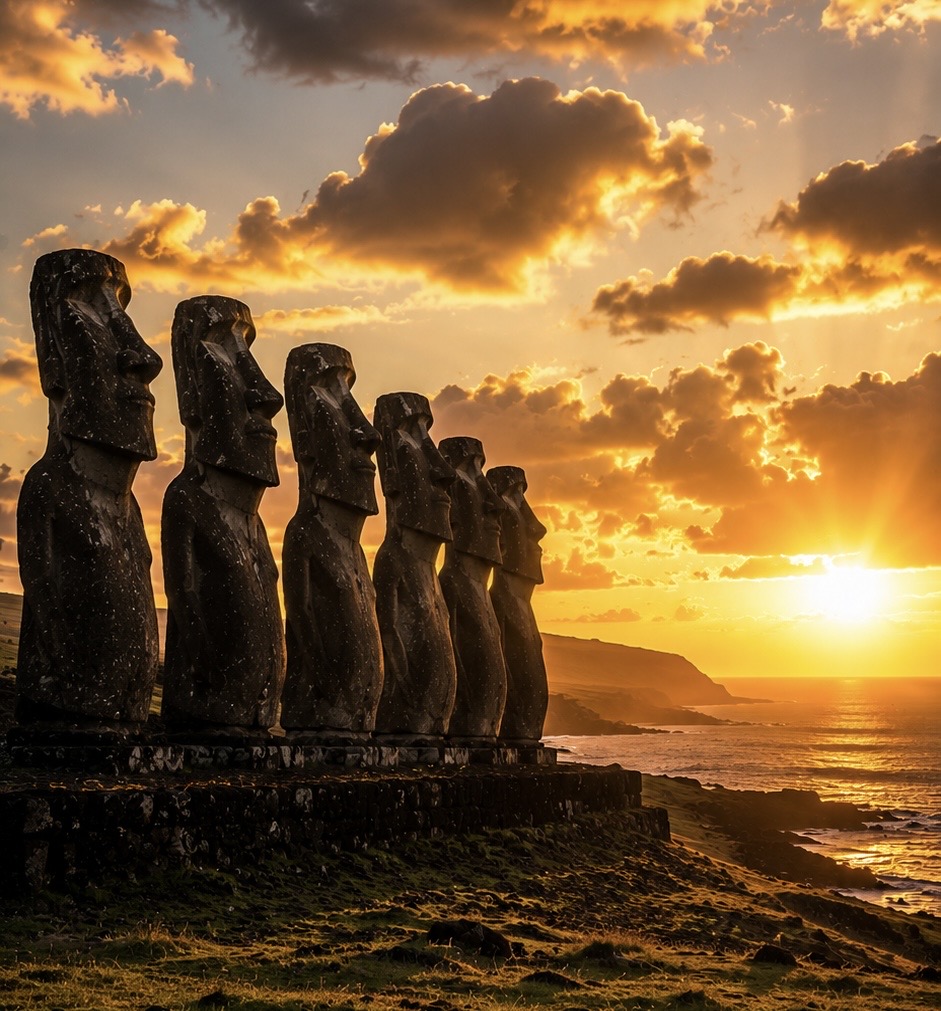
The Rapa Nui people carved close to nine hundred of these monoliths, most likely between the eleventh and fifteenth centuries, though the precise dates remain debated. Almost all of them came from a single place. Rano Raraku is an extinct crater of soft volcanic tuff, a stone yielding enough to be shaped with hand picks of harder basalt and yet durable enough to last a thousand years. The slopes of that crater are still crowded with around four hundred statues today, and they sit at every imaginable stage of creation.
Some are finished and waiting. Some lie abandoned mid-journey. And some were never freed from the rock at all.
This is the part of the story that visitors rarely hear. Scattered across the quarry are unfinished moai still fused to the bedrock that bore them, lying on their backs with their faces complete and their spines still joined to the mountain. The carvers worked the front and sides to a smooth finish first, and only at the very end intended to cut the back free and lower the figure down the slope. Many of them never reached that moment. The largest of these unborn giants stretches roughly twenty-one metres, a statue that, had it ever stood, would have dwarfed every other moai on the island and weighed in the region of two hundred tonnes. It remains where it was left, half made, as though the workers laid down their tools one afternoon and simply never returned.
That image of sudden abandonment has fed centuries of speculation, but the more grounded revelations came from the soil itself. In the 1950s the Norwegian explorer Thor Heyerdahl conducted some of the first excavations at Rano Raraku and confirmed what the slope had been hiding, that the heads ran deep and the bodies were there all along. Decades later a far more careful and scientific project, led by the archaeologist Jo Anne Van Tilburg, excavated two of the buried figures with the precision the site deserved. What they uncovered went beyond mere torsos.
The buried backs were carved. Protected from wind and rain for centuries by the very earth that hid them, the stone preserved markings that the exposed faces had long since lost. On one statue the team recorded a series of petroglyphs, including the shapes of Polynesian canoes, etched into the body where no casual eye would ever have seen them. There were traces of red pigment, evidence of post holes, and signs that the ground around the statues had been deliberately worked. The quarry, in other words, was not simply a workshop where statues were churned out and dragged away. Some of these figures may have been meant to stand exactly where they were, raised in place and venerated, rather than transported to the stone platforms along the coast.
Which brings us to the strangest rumour of all, the idea that the moai had something to do with houses.
It is not as baseless as it sounds, though it has been thoroughly tangled in the retelling. There is no serious theory that the statues themselves were dwellings. What there is, is a single famous moai with a peculiar history. Its name is Hoa Hakananai’a, and for a long stretch of the island’s later history it stood buried to the shoulders inside a stone house at the ceremonial village of Orongo. The house was not a home in any ordinary sense. It belonged to the birdman cult that rose to prominence after the great age of statue building had passed, and the building appears to have been constructed around the figure rather than the figure placed inside an existing room. In 1868 the crew of a British survey ship dismantled that house, dragged the statue to the shore and carried it away to London, where it sits in the British Museum to this day, its carved back still bearing the symbols of a religion that came long after its making.
So a moai really was found inside a house. The leap from there to the notion that moai were houses is the kind of compression that happens when a true and curious fact passes through enough hands.
The island did have its own distinctive dwellings, and perhaps that is where the rest of the confusion lies. The Rapa Nui built long, narrow homes called hare paenga, shaped like the upturned hull of a canoe and edged with carefully cut stone foundations. These sat near the ceremonial platforms and the quarry, woven into the same sacred landscape as the statues. To a later imagination, the stone foundations of a vanished house and the buried base of a vanished body are not so far apart.
What remains, once the rumours are set aside, is something stranger than any of them. A people on the most isolated inhabited island on earth carved an army of ancestors from a mountain, gave them bodies and faces and hidden markings on their backs, and then, for reasons still argued over, stopped. The earth did the rest, climbing slowly up their shoulders until the world forgot they had ever been anything more than heads.
The bodies were always there. We simply stopped looking below the surface, which is a habit the island seems determined to break us of.
A short video based on this topic on our After Eden Youtube channel.
If you enjoyed this article, you might be interested in reading all about Roman Fast Food: The Incredible Street Food Culture Frozen in Time at Pompeii.
Follow us on our socials below for daily videos, so YOU can be MORE interesting.
Sources
The Easter Island Statue Project (Jo Anne Van Tilburg’s team) at eisp.org is the authority for the buried torsos, the controlled excavations, and the carvings found on the backs. It’s the actual research project, so it’s your best anchor for the “the heads have bodies” core of the piece.
The British Museum’s page on the moai (britishmuseum.org) covers Hoa Hakananai’a, the stone house at Orongo, the birdman cult connection, and its removal in 1868. Since they physically hold the statue, that’s about as solid as it gets for the “found inside a house” section.
Encyclopaedia Britannica’s Easter Island archaeology entry backs the unfinished giant still attached to the bedrock (the roughly twenty-one metre one), the detail that the fronts were polished before the backs were cut free, and the statues facing inland.