The Man Who Sold the Eiffel Tower – Twice
In May 1925, a slim, well-dressed man sat in a suite at the Hôtel de Crillon, one of the most prestigious addresses in Paris. He introduced himself to a small gathering of businessmen as a deputy director-general of the French Ministry of Posts and Telegraphs. His stationery was immaculate. His manner was calm, assured, and faintly burdened, the quiet exhaustion of a man tasked with delivering unfortunate news on behalf of the Republic.
The news was this: the Eiffel Tower was falling apart. Maintenance costs had become unsustainable. The government had quietly decided to dismantle it and sell the iron for scrap. Over seven thousand tonnes of it. But the matter was politically sensitive, and discretion was essential. These men, all respected scrap metal dealers, had been handpicked to submit bids.
Every word of it was a lie.
The man’s name was Victor Lustig, and he was about to pull off what is still considered one of the most audacious confidence tricks in history.
Lustig was born in 1890 in Hostinné, a small town in Bohemia, then part of the Austro-Hungarian Empire. He was bright, restless, and drawn to trouble from a young age. By his late teens he was gambling in the cafés of Paris, where a jealous boyfriend gave him a scar down the left side of his face. A mark he would carry for the rest of his life. He spoke five languages fluently, adopted aristocratic titles with ease, and by his twenties had drifted into a career of fraud that would eventually make him wanted by law enforcement agencies across two continents.
But nothing in his long catalogue of swindles would rival what he did in that Parisian hotel suite.
Lustig had spotted a small newspaper article lamenting the cost of maintaining the Eiffel Tower. The tower had been built for the 1889 Exposition Universelle and was never intended to be permanent. In artistic circles it was widely considered an eyesore. It was, in other words, the perfect mark. A structure the city was already half-embarrassed by. He hired a forger to produce convincing government documents, rented a limousine, and invited six scrap dealers to submit sealed bids.
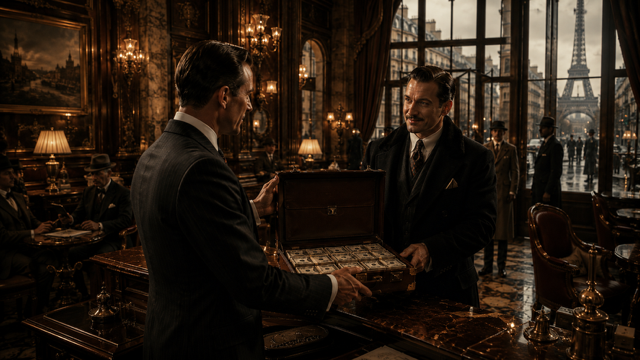
Then he identified his target: André Poisson, a dealer who was eager to break into the Parisian business elite but lacked the connections. Lustig sensed the insecurity immediately and played it beautifully. He took Poisson aside and, lowering his voice, hinted that a small private payment might help ensure the contract went to the right man. A bribe. It was the detail that made the whole thing sing, because what kind of government official asks for a bribe? A real one. Poisson paid the asking price for the tower and the bribe on top. By the time he realised what had happened, Lustig had vanished to Austria with a suitcase full of francs.
Poisson was too humiliated to go to the police.
When no story appeared in the papers, Lustig returned to Paris and ran the exact same scheme a second time, with a new group of dealers. This time the victim did contact the authorities, but Lustig slipped away before they could arrest him.

He drifted to the United States, where his cons grew bolder. He sold a fictional money-printing machine which is a small wooden box with rollers and dials that he claimed used radium to duplicate banknotes and to victims across the country, including a sheriff in Texas. He invented Broadway productions and convinced wealthy passengers on ocean liners to invest in them. And then, in the early nineteen thirties, he did something that even seasoned criminals considered suicidal.
He went after Al Capone.
Lustig travelled to Chicago and requested a private meeting with the most feared gangster in America. He outlined an investment opportunity and asked Capone for fifty thousand dollars, promising to double it within sixty days. Capone, suspicious but intrigued, handed over the money. Lustig took the cash, placed it in a safe deposit box, and did absolutely nothing with it.
Two months later, he returned to Capone’s office. He told the gangster the deal had fallen through. Then, before Capone could reach for a weapon or summon his men, Lustig calmly produced the full fifty thousand dollars and handed it back with an apology.
Capone was stunned. In his world, no one returned the money. He was so impressed by what he took to be extraordinary honesty that he peeled off five thousand dollars and pressed it into Lustig’s hands. A reward for playing it straight.
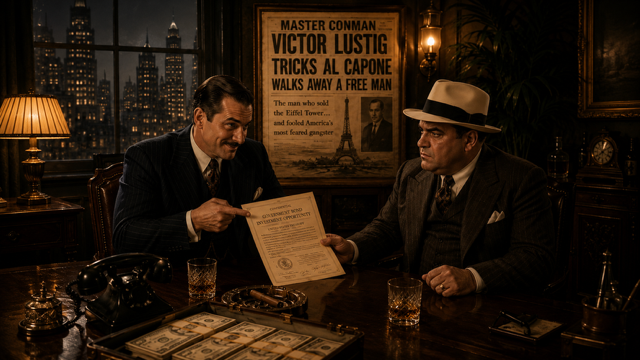
That had been Lustig’s plan all along. He never wanted the fifty thousand. He wanted the tip.
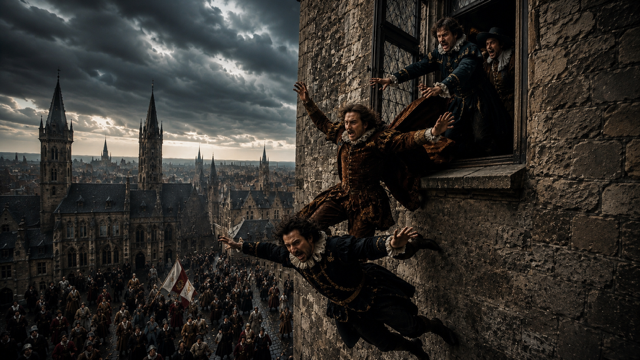
It could not last, of course. By the mid-nineteen thirties, Lustig had turned to industrial-scale counterfeiting. His operation was producing such convincing fake bills that the United States Secret Service launched a dedicated investigation to bring him down. He was arrested in 1935, and in a final act of theatrical defiance, escaped from a federal detention centre in Manhattan by climbing down a rope made from bedsheets. He was recaptured twenty-seven days later in Pittsburgh.
Lustig was sentenced to twenty years and sent to Alcatraz. He filed over a thousand medical complaints during his incarceration, most of which were ignored. His health eventually and genuinely declined. He was transferred to the federal medical facility in Springfield, Missouri, where he died of pneumonia on the eleventh of March, 1947.
His death went unreported for more than two years.
On his death certificate, in the space reserved for occupation, someone with a sharp sense of irony wrote two words: apprentice salesman.
It is tempting to admire Victor Lustig. The audacity, the charm, the sheer theatrical nerve of a man who sold a national monument and walked away whistling. But there is something darker beneath the performance. Every one of his victims was chosen not for their greed alone, but for their vulnerability, their loneliness, their ambition, their desperate need to believe that the world might, just this once, tilt in their favour. Lustig did not simply lie to people. He found the thing they most wanted to be true, and he made it real just long enough for them to hand over everything.
Perhaps that is the real lesson of the man who sold the Eiffel Tower. The con was never really about the tower at all. It was about the human need to believe and how easily that need can be turned into someone else’s profit.
A short video on this topic from our After Eden Youtube Channel
If you enjoyed this article, you might like to read the incredible story about Violet Jessop: The Women Who Survived Three Shipwrecks.
For daily videos, subscribe or follow us on our socials below.