Göbekli Tepe – The 12,000-Year-Old Temple That Rewrote Human History
Reading time: approx. 7–8 minutes
Before the pyramids of Egypt. Before Stonehenge. Before the first cities of Mesopotamia. Before writing, before agriculture, before everything we were taught marks the beginning of human civilisation, someone was already building temples.
Not crude shelters. Not simple stone arrangements. Temples. Massive, deliberately constructed, elaborately carved places of worship, built with an organisational sophistication and architectural ambition that, according to everything archaeologists thought they knew about prehistoric humanity, simply should not have been possible.
The site is called Göbekli Tepe. It sits on a limestone ridge in the Taurus Mountains of southeastern Turkey, overlooking the plains of ancient Mesopotamia. And since its rediscovery in 1994, it has quietly and comprehensively dismantled the story we thought we knew about the origins of human civilisation.
This is the discovery that forced archaeologists to ask a question nobody was prepared for: what if we have the timeline of human history completely wrong?
The deeper researchers dig — literally and figuratively — the more extraordinary the picture becomes. And one detail in particular, buried at the heart of Göbekli Tepe’s story, raises questions that nobody has yet been able to answer.
The Shepherd and the Stone
In 1963, the University of Chicago conducted an archaeological survey of the region and noted the presence of flint fragments on a hilltop near the town of Şanlıurfa. They wrote it off as a medieval cemetery and moved on. For thirty years, Göbekli Tepe sat undisturbed, its secrets buried under centuries of accumulated earth and debris.
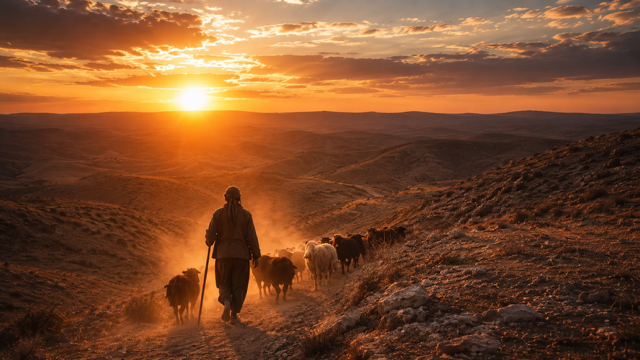
Then, in 1994, a Kurdish shepherd named Şavak Yıldız was walking the hills when he noticed something unusual protruding from the ground. Large, flat-topped stones, jutting from the earth at regular intervals. He reported it to a local museum, and German archaeologist Klaus Schmidt arrived to investigate.
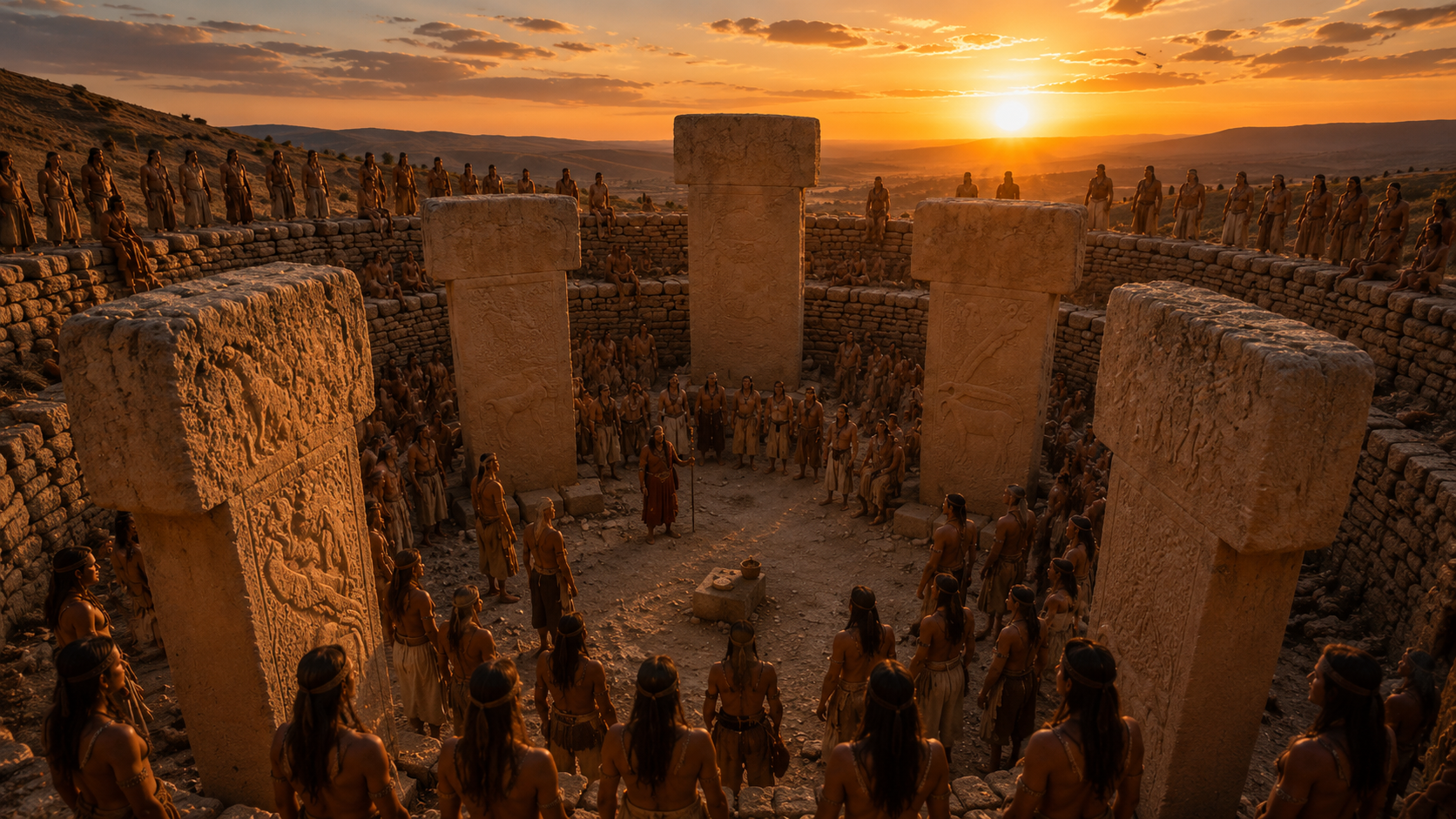
Schmidt immediately understood he was looking at something extraordinary. What the shepherd had stumbled across were the tops of massive T-shaped limestone pillars. The largest standing nearly six metres tall and weighing up to 20 tonnes each. These were all arranged in precise circular formations and buried deliberately underground.
Schmidt dedicated the rest of his life to excavating the site. What he found there changed archaeology forever.
Schmidt knew immediately this was not a cemetery. This was a temple. The oldest temple ever found.
What Is Göbekli Tepe?
Göbekli Tepe which translates roughly as ‘Potbelly Hill’ in Turkish is a megalithic sanctuary dating to approximately 9,600 BC, making it at least 11,600 years old. For context, the Great Pyramid of Giza was built around 2,560 BC. Stonehenge began construction around 3,000 BC. The earliest known writing dates to around 3,200 BC.
Göbekli Tepe predates all of them. By thousands of years.
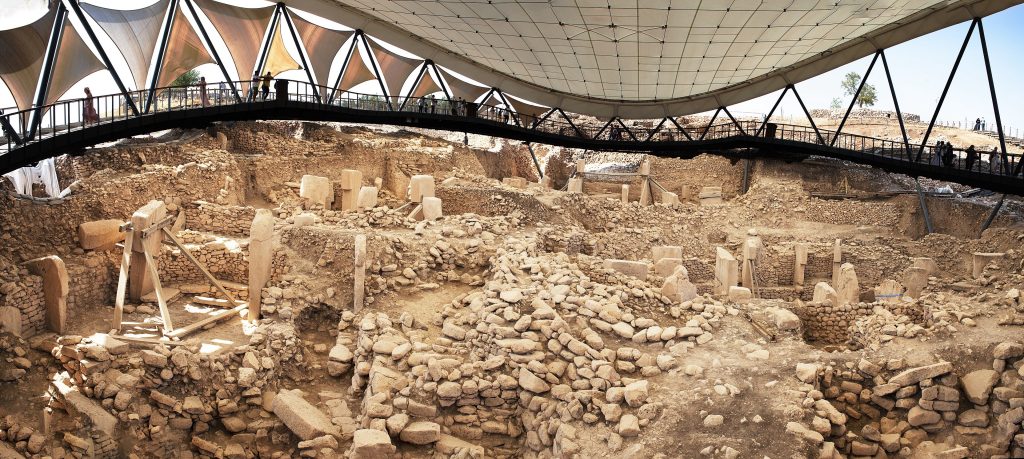
The site covers an area of around 300 football fields, though only a fraction has been excavated so far, ground-penetrating radar surveys suggest there are at least 20 circular enclosures still buried beneath the surface. Each enclosure consists of a ring of T-shaped limestone pillars, some plain and some covered in extraordinarily detailed carvings.
The Pillars
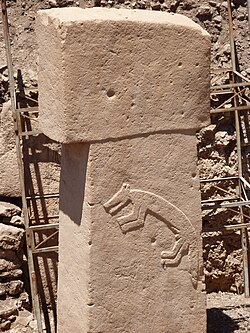
The pillars themselves are among the most remarkable things about the site. Quarried from the limestone bedrock of the surrounding plateau and some of the quarry stones are still visible, abandoned mid-extraction as if the workers simply walked away one day where they were shaped, transported, and erected without the use of metal tools, wheels, or domesticated animals.
The largest pillars stand nearly six metres tall and weigh up to 20 tonnes. Moving them from the quarry to the building site would have required the coordinated effort of hundreds of people working together over an extended period. A level of social organisation that, according to the prevailing model of prehistoric human society, hunter-gatherers in 9,600 BC were not supposed to possess.
The central pillars in each enclosure are particularly striking. They are carved in a way that strongly suggests they represent human or humanoid figures — with arms carved in relief along their sides, hands with fingers, and belts and loincloths carved at their waists. Whatever or whoever these pillars represent, they were not accidental. They were intentional. Deliberate. Meaningful.
The Carvings
If the pillars themselves are astonishing, the carvings that cover them are breathtaking. Animals of every kind are depicted in extraordinary detail — foxes, lions, bulls, snakes, vultures, scorpions, spiders, cranes, ducks and more, all rendered with an artistic skill and naturalistic precision that speaks to a sophisticated visual tradition. These are not the simple scratches of a primitive people. These are the works of skilled artists working within an established artistic culture.
Some of the carvings appear to tell stories. Others may represent constellations. Some researchers have suggested that certain arrangements of animals correspond to specific star patterns visible in the night sky around 10,000 BC which is a possibility that, if confirmed, would suggest the builders of Göbekli Tepe had a detailed working knowledge of astronomy millennia before such knowledge was supposed to exist.
There are also symbols and abstract markings that appear repeatedly across the site that nobody has yet been able to fully decode. They predate the earliest known writing systems by thousands of years, but their repetition and apparent systematisation suggests they may represent a form of proto-writing or symbolic communication we simply don’t yet have the tools to read.
The Problem Nobody Saw Coming
Here is where Göbekli Tepe stops being merely extraordinary and starts being genuinely revolutionary.
The standard model of human prehistory, the one taught in schools and universities for generations, goes something like this: hunter-gatherers roamed the landscape in small, nomadic bands, surviving day to day on whatever they could find or kill. Then, around 10,000 BC, humans in the Fertile Crescent discovered agriculture and the ability to grow crops and domesticate animals. This agricultural revolution allowed people to settle in one place, produce surplus food, develop specialisation of labour, build permanent structures, create social hierarchies, and eventually give rise to the first civilisations.
In other words: agriculture first, then settlement, then complexity, then religion, then temples.
Göbekli Tepe turns that sequence completely upside down.
The people who built Göbekli Tepe were hunter-gatherers. They had no agriculture. No cities. No writing. And yet they built a temple complex of staggering scale and sophistication.
The archaeological evidence is unambiguous on this point. There are no domesticated plant or animal remains at Göbekli Tepe from its earliest phases. The people who gathered here, and they must have gathered in significant numbers to build what they built, were hunter-gatherers. Pre-agricultural. Pre-settlement. Pre-everything we thought was necessary for this level of organised, purposeful, architecturally ambitious construction.
Klaus Schmidt’s conclusion, which has since become the dominant interpretation among archaeologists, was radical: it wasn’t agriculture that created the conditions for civilisation. It was religion. The desire to gather, to worship, to build something sacred is that impulse came first. And it was the need to feed the people who gathered at places like Göbekli Tepe that eventually drove the development of agriculture, not the other way around is a theory.
The temple didn’t come after civilisation. The temple created it.
The Detail Nobody Talks About
Everything described so far would be enough to make Göbekli Tepe one of the most important archaeological discoveries in history. But there is one more detail. The detail at the heart of the this subject which I would like to elevate it from remarkable to genuinely haunting.
Whoever built Göbekli Tepe didn’t abandon it.
They buried it.
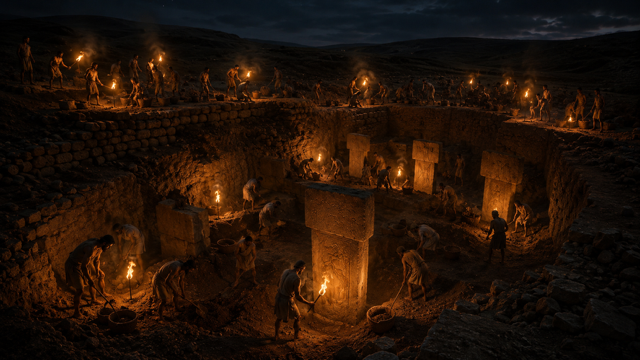
Deliberately, carefully, and completely. Every pillar. Every enclosure. Every carved surface. Around 8,000 BC after the site had been in use for roughly 1,500 years, the builders backfilled the entire complex with soil, flint fragments, and animal bones, burying it under metres of carefully deposited material. Then they walked away.
But the real question is, did they abandon and hide it, or did they try and preserve it to found again one day?
This was not erosion. This was not natural accumulation. This was intentional. The backfill was deposited in a way that actually preserved the site remarkably well which is why the carvings are still so crisp and detailed after 12,000 years. Some researchers have suggested that the burial was itself a ritual act, a deliberate interment of something sacred. Others have proposed more practical explanations. Perhaps protection from enemies, or a response to some environmental catastrophe.
But nobody really knows. The question of why Göbekli Tepe was buried and why an entire civilisation’s most sacred site was deliberately hidden underground, remains one of the great unanswered questions of archaeology.
What we do know is this: by burying it, whoever built Göbekli Tepe ensured it would survive. Ensured that one day, a Kurdish shepherd would walk those hills and notice something strange sticking out of the ground. Ensured that we would find it, excavate it, and be forced to confront everything it tells us about who we are and where we came from.
What Göbekli Tepe Tells Us About Ourselves
The implications of Göbekli Tepe extend far beyond archaeology. They reach into philosophy, theology, and the deepest questions about human nature.
If hunter-gatherers with no agriculture, no cities, and no writing were capable of conceiving, organising, and executing a construction project of this scale and sophistication yet driven not by practical necessity but by spiritual impulse. Then what does that tell us about the human capacity for transcendence? About the depth of our need to reach beyond the immediate and the material, to build something that points toward something larger than ourselves?
It tells us that this impulse is not a product of civilisation. It is older than civilisation. It may, in fact, be what produced civilisation.
And it raises a question that, once asked, is very difficult to stop thinking about: if this is what we know about, what don’t we know about? How many other Göbekli Tepes are out there, buried under hills and deserts and ocean floors, waiting for another shepherd, another storm, another stroke of luck to bring them back to the surface?
History isn’t a straight line from primitive to advanced. It is a landscape of peaks and valleys and we are only just beginning to find the peaks.
Göbekli Tepe is not an anomaly. It is a reminder. A reminder that the ancient world was vastly more complex, more sophisticated, and more spiritually alive than the textbooks have led us to believe. A reminder that the forgotten truths of our past are not gone. They are buried, preserved, waiting.
Just like the temple itself.
Visit Göbekli Tepe
Göbekli Tepe is a UNESCO World Heritage Site and is open to visitors in Şanlıurfa Province, southeastern Turkey. A purpose-built walkway allows visitors to view the excavated enclosures without disturbing the site. The nearby Şanlıurfa Archaeology Museum houses many of the artefacts recovered from the excavation, including some of the extraordinary carved pillars.
If you find yourself in Turkey, it is one of the most profound places on earth to stand. Not because of what you can see, although what you can see is extraordinary, but because of what it represents. Twelve thousand years ago, people stood in this same place, looked up at the same stars, and felt the same pull toward something beyond themselves that we still feel today.
That continuity across twelve millennia is, perhaps, the most remarkable thing about Göbekli Tepe of all.
Keep Exploring
At After Eden, we believe the most important stories aren’t always the ones that made it into the history books. Sometimes the most important stories are the ones that were buried. Whether deliberately or otherwise and are only now coming back to light.
Göbekli Tepe is one of those stories. And it is far from alone.
Subscribe to the After Eden YouTube channel for a new Short every day, or follow us on Facebook using our social links below.
Ancient Worlds. Forgotten Truths. Eternal Questions.