The Library of Alexandria: History, Knowledge, and the Legend of Its Destruction
There are few places in history that have captured the human imagination quite like the Library of Alexandria. For centuries it has stood as a symbol of everything civilisation can achieve and everything it can lose. It was a place where the greatest minds of the ancient world gathered to read, debate, and push the boundaries of human understanding. And then, the story goes, it burned. But the truth, as with so many things from the ancient world, is far more complicated and far more interesting than the legend.
The Birth of a Dream
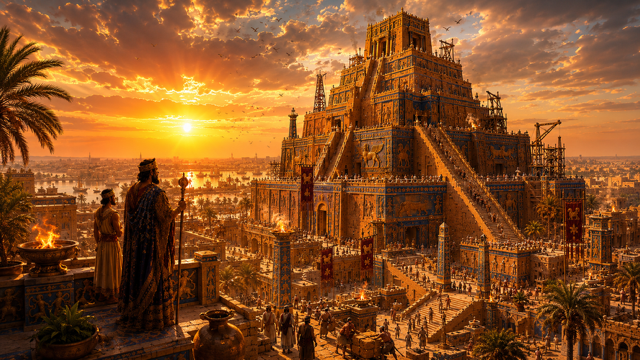
The Library of Alexandria was founded in the third century BC in the Egyptian city ofAlexandria, a metropolis established by Alexander the Great following his conquest of Egypt in 331 BC. After Alexander’s death, one of his generals, Ptolemy I Soter, took control of Egypt and set about building one of the most remarkable cities the world had ever seen. His son, Ptolemy II Philadelphus, continued this ambition and is widely credited with transforming Alexandria into an intellectual powerhouse.
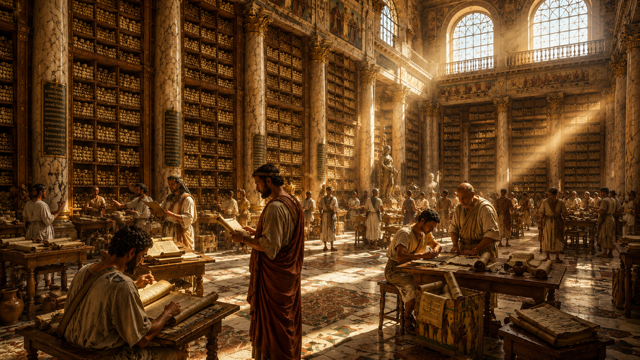
The Library was not simply a building full of scrolls. It was part of a much larger institution called the Mouseion which is a word from which we derive our modern term “museum.” The Mouseion was essentially an ancient university, a place where scholars from across the Mediterranean world were invited to live, study, eat, and think, all at the expense of the Ptolemaic crown. The Library itself was the beating heart of this institution, and its mission was breathtakingly ambitious: to collect every book in the world.
A Collection Beyond Imagination
At its height, the Library of Alexandria is believed to have held somewhere between 400,000 and 700,000 papyrus scrolls. These were not just Egyptian texts. The Ptolemaic rulers sent agents across the known world to acquire works from Greece, Persia, India, and beyond. Ships arriving in Alexandria’s famous harbour were reportedly searched, and any scrolls found on board were confiscated and copied and with the copies sometimes returned to the owners and the originals kept for the Library.
The collection included works of philosophy, mathematics, astronomy, medicine, poetry, drama, history, and natural science. Many of the texts that shaped Western civilisation passed through Alexandria. Works by Aristotle, Euclid, Archimedes, Eratosthenes, and Hippocrates were housed here.
Eratosthenes, who served as the Library’s chief librarian, famously used the Library’s resources to calculate the circumference of the Earth with remarkable accuracy around 240 BC, more than 1,700 years before Columbus sailed west.
The Scholars Who Made It Great
The Library attracted some of the finest minds of the ancient world. Euclid, whose work on geometry remained the definitive text on the subject for over two thousand years, is believed to have worked in Alexandria. Archimedes, the legendary mathematician and inventor, may have studied there as a young man. Hypatia, one of the ancient world’s few known female scholars, taught philosophy and mathematics in Alexandria in the late fourth and early fifth centuries AD, and her story became tragically intertwined with the Library’s final decline.
The chief librarians, known as the heads of the Mouseion, were themselves distinguished scholars appointed by the Ptolemaic kings. Among them was Callimachus, a poet and critic who created the Pinakes which was an enormous catalogue of Greek literature that is considered one of the earliest attempts at systematic bibliography.
The Library was not simply a passive repository. It was a living, working institution that produced scholarship, commentary, and original thought.
The Truth About Its Destruction
Ask anyone what happened to the Library of Alexandria and they will almost certainly tell you it burned. The image is a powerful one. A single catastrophic fire consuming the ancient world’s greatest treasure. But historians today believe the reality was quite different.
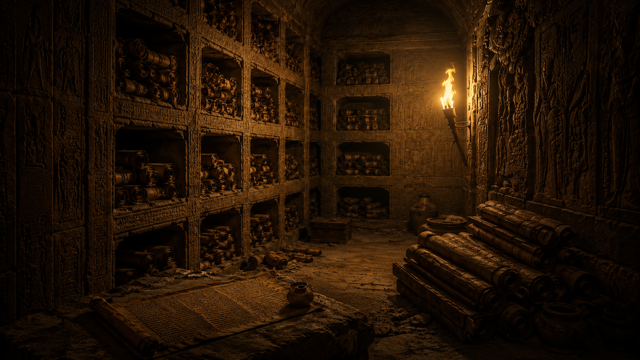
The Library did not die in a single dramatic moment. It declined slowly, over several centuries, through a combination of neglect, political upheaval, and funding cuts.
Julius Caesar is often blamed for the first great blow. During his military campaign in Alexandria in 48 BC, a fire broke out near the harbour that may have destroyed a warehouse containing tens of thousands of scrolls waiting to be catalogued. Whether this was the Library itself or an overflow storage facility remains debated among historians. Caesar’s own accounts make no mention of burning a library, and ancient sources differ on the scale of the damage.
The Roman emperor Aurelian dealt another blow in 270 AD when his forces attacked Alexandria’s royal quarter. The district where the Library was housed, during a military campaign. Then, in 391 AD, the Christian emperor Theophilus ordered the destruction of Alexandria’s pagan temples, and the Serapeum which is a secondary library attached to the great Temple of Serapis and it was reportedly destroyed by a Christian mob.
It was around this time that Hypatia was murdered by a mob in the streets of Alexandria, an act that has come to symbolise the end of the ancient world’s spirit of open inquiry. The final chapter came with the Arab conquest of Egypt in 641 AD, though most modern historians dismiss the famous story that the Arab general Amr ibn al-As burned the remaining scrolls on the orders of the Caliph Omar as a later fabrication.
What the historical record actually suggests is a gradual erosion. A slow dimming rather than a sudden extinguishing. Funding dried up. Scholars went elsewhere. Scrolls deteriorated and were not replaced. The Library did not so much burn as it quietly faded from the world.
Why It Still Matters
The legend of the Library of Alexandria endures because it speaks to something deep in the human spirit. Our love of knowledge, and our fear of losing it. The idea that so much wisdom could simply vanish, that works of philosophy, science, and literature were lost forever to fire or neglect, is genuinely heartbreaking. We will never know exactly what was contained in those hundreds of thousands of scrolls. Some of it may have been trivial. Some of it could have changed the course of history.
What the Library represents, more than anything, is the radical idea that knowledge should be gathered, preserved, and shared. That idea did not die with Alexandria. It lived on in the great Islamic libraries of the medieval period, in the monasteries of Europe, and eventually in the public libraries, universities, and, yes even the internet of our own age.
The Library of Alexandria was not perfect. It was an instrument of Ptolemaic power as much as it was a beacon of learning. But it was also something genuinely extraordinary. A place where human curiosity was given resources, time, and space to flourish. In that sense, its story is not simply a tragedy. It is also an inspiration.
The ancient world built the greatest library it could imagine. The question it leaves for us is whether we are brave enough to do the same. Perhaps if the library was not destroyed, we would have been able to solve other mysteries such as the famous Baghdad Battery, and The Antikythera Mechanism.