The Tower of Babel and Its Connection to Ancient Babylon
For thousands of years, the Tower of Babel was treated as little more than a moral fable. It was more of a story about human pride, divine punishment, and the origin of the world’s many languages. Skeptics dismissed it as mythology. Believers accepted it on faith. But neither group expected what archaeologists would eventually pull out of the Iraqi desert.
Because buried beneath the ruins of ancient Babylon was something extraordinary: the physical remains of a real tower. A massive, sky-reaching structure that may be the very inspiration behind one of the most famous stories ever told. The connection between the biblical Tower of Babel and the ancient city of Babylon is not a matter of speculation. It is, increasingly, a matter of archaeology.
What the Bible Actually Says
The story of the Tower of Babel appears in Genesis chapter 11. After the great flood, the narrative tells us that all of humanity shared a single language and gathered together in a land called Shinar which is a name widely identified by scholars as ancient Mesopotamia, in modern-day Iraq.
There, this unified people decided to build a city and at its heart, a tower that would reach the heavens. The motivation, as the text frames it, was pride. A desire to make a name for themselves and avoid being scattered across the earth. God looked down, saw what they were building, and intervened. He confused their language, scattered the people across the face of the earth, and the great tower was left unfinished.
The place was called Babel, which in Hebrew sounds remarkably like the word for confusion. But in ancient Akkadian, the language of Mesopotamia, the very same word carried an entirely different meaning. Babel, or Bab-Ilu, meant Gate of God.
Enter Babylon — City of the Gate of God
Babylon was one of the greatest cities the ancient world ever produced. Located in modern Iraq, roughly 85 kilometres south of Baghdad, it served as the beating heart of a powerful empire. At its peak under King Nebuchadnezzar II around 600 BC, Babylon was arguably the most magnificent and formidable city on the planet.
And at the centre of this great city stood something that should immediately catch the attention of anyone familiar with Genesis 11.
A tower.
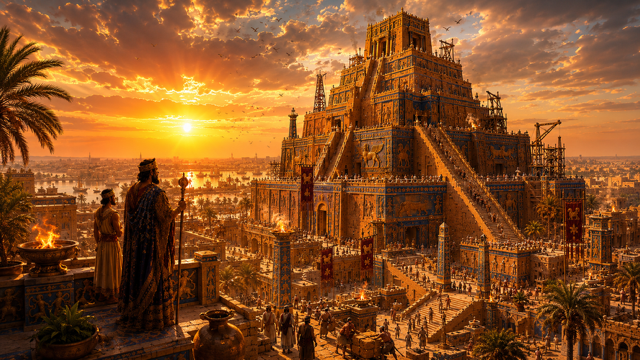
A massive, stepped temple pyramid called Etemenanki which is a Sumerian name meaning House of the Foundation of Heaven and Earth. Ancient texts describe it as a seven-tiered ziggurat with a temple to the chief god Marduk at its very peak. Historians estimate it may have reached 90 metres into the sky. That’s nearly 300 feet, which, standing on the flat plains of Mesopotamia, would have been a breathtaking and almost incomprehensible sight.
A tower. In the city called Gate of God. Literally named the foundation connecting heaven and earth.
What the Archaeologists Found
The Greek historian Herodotus visited Babylon in the 5th century BC and described the tower in remarkable detail. He described it as a vast central structure rising in successive terraces, visible for miles across the Mesopotamian plain. While Herodotus is not always perfectly reliable, his description is consistent enough to be taken seriously by historians.
Then came the archaeologists.
In 1913, German archaeologist Robert Koldewey finished excavating a remarkable find in the ruins of Babylon: a massive square foundation, roughly 90 metres on each side. This was the footprint of Etemenanki which is a physical, measurable, undeniable proof that this tower was not a legend. It was real.
The Nebuchadnezzar Tablet
Perhaps the most compelling piece of evidence is a clay tablet now known as the Tower of Babel Stele, dating to around 600 BC and held in the Schoyen Manuscript Collection.
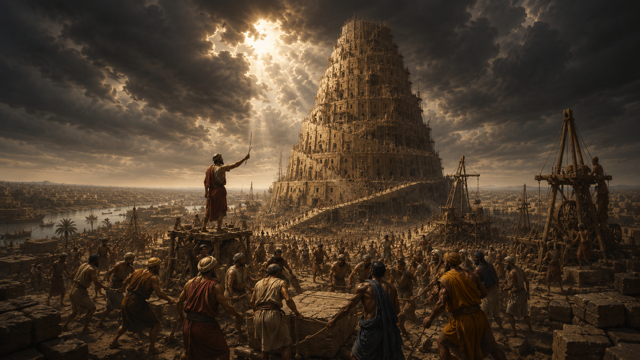
The tablet depicts King Nebuchadnezzar II standing before a massive stepped tower. The accompanying inscription records the king boasting about his construction of Etemenanki and describing how he gathered people from across his vast empire, speakers of many different languages, to build it.
Many languages. Many peoples. Building a sky-reaching tower in the city of Babel.
The parallels with Genesis 11 are difficult to dismiss.
The Israelites Who Saw It With Their Own Eyes
Here is where the story becomes deeply personal and historically grounded.
Between 597 and 538 BC, the ancient Israelites were taken as captives to Babylon during what is known as the Babylonian exile. They lived in the city. They walked its streets. They saw Etemenanki rising above the skyline. Some may have been compelled to work on its construction or restoration under Nebuchadnezzar himself.
And they looked at this enormous, imposing monument to imperial power and human ambition. This symbol of everything Babylon represented and they told a story about it.
A story about a people with one language. A tower reaching to heaven. A God who intervened. And a monument left unfinished.
Was the Tower Ever Finished?
Here is one of the most overlooked details in this entire story: Etemenanki was almost certainly never completed.
Ancient records suggest the structure went through multiple phases of construction and destruction across centuries. The Assyrian king Sennacherib may have destroyed an earlier version of the tower. Later rulers attempted to restore it. By the time Alexander the Great arrived in Babylon in 323 BC, the tower was reportedly in a state of ruin. Alexander ordered its demolition to clear the site for an ambitious rebuilding project. One that never happened, because Alexander died shortly after giving the order.
The great tower of Babel, if Etemenanki is indeed its inspiration was left unfinished. Just as the Bible described.
A Story Older Than Babylon
Some scholars go even further. They argue that the Tower of Babel narrative is not specifically about Etemenanki at all, but draws on a much older and broader Mesopotamian tradition of ziggurat building.
Because Babylon was not unique. Every major Mesopotamian city had its own version of this structure. Ur had one. Uruk had one. Eridu which is possibly the oldest city on earth also had one. The impulse to build toward the sky, to reach the divine, to make a name for your civilization in brick and mortar, was woven into Mesopotamian culture for thousands of years before Nebuchadnezzar ever picked up a chisel.
Perhaps, then, the Tower of Babel is not the story of one building. Perhaps it is the story of an entire civilization’s obsession with reaching heaven and the theological reflection of one people who looked at that obsession and saw a warning.
A Ruin That Still Speaks
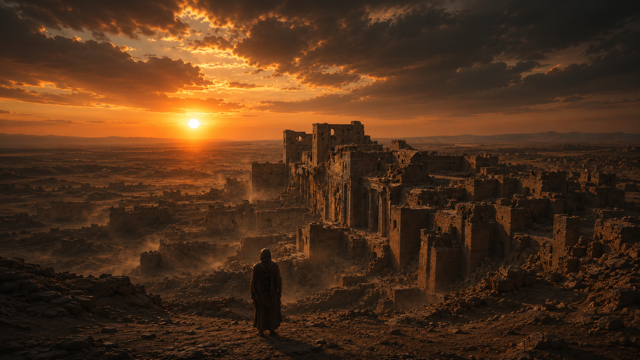
The ruins of Etemenanki still exist today. A crumbling square of ancient brick sitting in the Iraqi desert, largely unknown to the modern world. No tourist buses. No museum exhibit. Just sun-baked earth and silence where a structure once stood that may have inspired the world’s most enduring story about human ambition.
Whether Genesis 11 is a literal historical account, a theological reflection on Babylon, or an ancient memory of a culture-wide obsession with sky-high temples, the connection to real history is undeniable. The city was real. The tower was real. The people who saw it and told stories about it were real.
And three thousand years later, we are still asking the same questions they were.
A similar story on weather the flood of Noah from the bible and Plato’s famous theory on the lost city of Atlantis is the same thing? Read it about it here.
What happens when humanity reaches too high?
Ancient Worlds. Forgotten Truths. Eternal Questions. – After Eden